
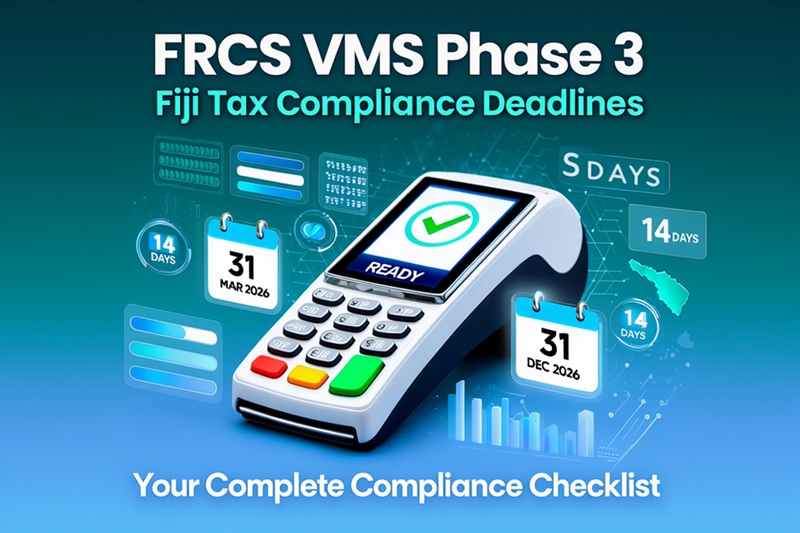
FRCS has confirmed the official VAT Monitoring System (VMS) Phase 3 timelines, including registration and implementation due dates by business group. If your business has a gross annual turnover of $50,000 or more, these timelines matter — and planning early can prevent last-minute POS disruption.
Why this update matters
When new compliance timelines are published, the biggest risks are usually not “technology problems” — they’re planning problems: waiting too long, choosing the wrong approach, or discovering too late that your POS setup needs an integration layer for VMS Version 3.
The good news: most businesses can prepare in a structured way. You don’t need panic. You need a clear checklist and a realistic plan.
What is VMS (VAT Monitoring System) in simple terms?
VMS is a fiscal compliance system focused on reporting sales data in a regulated way. In practice, this means your sales transactions (usually from a POS or billing system) must follow required rules and timelines — and your implementation must be aligned with FRCS requirements.
That’s why “accounting software” and “POS software” are not the same as “VMS compliance.” VMS typically requires a compliance layer that sits close to the transaction flow.
FRCS Phase 3 timelines (registration and implementation)
Below is a simplified view of the Phase 3 timelines FRCS confirmed. Use this table to identify your group and the dates that apply to you. (For exact group definitions, always refer to the Gazette notice and FRCS guidance.)
| Group of Businesses | Registration Due | Implementation Due |
|---|---|---|
| Architecture & Engineering | 30 Sep 2025 | 31 Dec 2025 |
| Construction | 30 Sep 2025 | 31 Dec 2025 |
| Real Estate | 30 Sep 2025 | 31 Dec 2025 |
| Service Stations | 30 Sep 2025 | 31 Dec 2025 |
| Commercial Health Care | 31 Dec 2025 | 31 Mar 2026 |
| Food Services | 31 Dec 2025 | 30 Jun 2026 |
| Freight Services | 31 Dec 2025 | 31 Mar 2026 |
| Accommodation Group 1 | 31 Mar 2026 | 30 Jun 2026 |
| Accommodation Group 2 | 30 Jun 2026 | 30 Sep 2026 |
| Wholesalers, Manufacturers & Retailers | 30 Jun 2026 | 31 Dec 2026 |
Note: Some dates were clarified by FRCS (for example, Food Services implementation). If you’ve seen older posts or screenshots circulating, rely on the most recent FRCS notice as the source of truth.
Version 2 vs Version 3: what you should know now
FRCS has also clarified the transition window and the end date for Version 2. This matters for planning, testing, and vendor selection.
- Version 2 continues for Phase 1 and Phase 2 groups until the transition end date.
- FRCS will cease Version 2 at the end of the transition period.
- Phase 3 groups (Gazette Notice 61 of 2025) are required to register on Version 3.0 following the registration and implementation timelines.
Practical takeaway: even if your business can run on Version 2 for part of the transition, the market is moving to Version 3 — and it’s better to design your POS integration for V3 early, not late.
A simple compliance plan for businesses and POS vendors
Whether you are a business operating a POS, or a POS vendor supporting multiple customers, this phased approach reduces risk:
-
Confirm your category and dates
Identify your business group and confirm your registration and implementation deadlines. -
Audit your POS setup
List your POS devices, locations, number of cashiers, invoice flow, and internet reliability. -
Decide your integration approach
The key question: will your POS connect directly, or will you use a dedicated compliance layer designed for VMS? -
Plan testing early
Integration testing always takes longer than expected — especially with multiple sites or older POS systems. -
Roll out in a controlled way
Start with one site or a pilot group of devices, then expand once stable.
Where FiscoBridge SDC fits
FiscoBridge SDC is built as a practical compliance layer for POS devices — designed to help businesses and POS vendors meet VMS requirements without replacing their existing POS system.
- POS-focused integration: connect your POS to the compliance layer using a simple API approach.
- Rollout-friendly: supports structured implementation for multi-device environments.
- Designed for VMS Version 3 readiness: helps future-proof your setup during the transition period.
If you are a POS vendor, this also becomes a repeatable implementation model: integrate once, then deploy consistently for multiple customers.
Quick checklist: are you at risk of a late implementation?
- You don’t know which Phase 3 business group you fall under.
- You have multiple POS devices or multiple sites and no rollout plan.
- Your POS is older, custom, or relies on unstable connectivity.
- You haven’t confirmed how your POS will meet VMS Version 3 reporting requirements.
- You’re waiting for “the last month” to start integration and testing.
If any of these sound familiar, the best move is to start with a simple technical review now — long before the implementation deadline.
Next steps
If you want, we can help you assess your current POS setup and propose a clean path to VMS compliance aligned with the Phase 3 deadlines. That includes integration approach, rollout plan, and the steps needed to avoid downtime or last-minute surprises.