
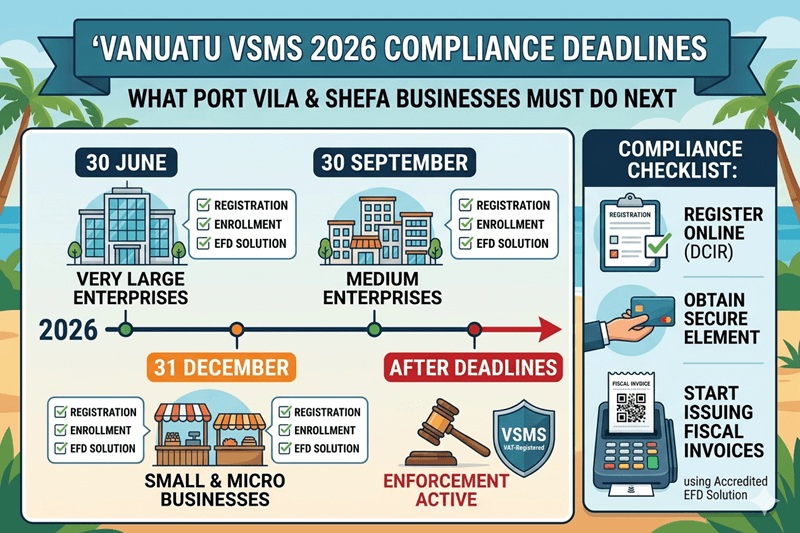
The Vanuatu Sales Monitoring System (VSMS) is now in enforcement, and VAT-registered businesses in Port Vila and the wider Shefa Province must prepare for their 2026 compliance deadlines.
For many businesses, this means more than just registering online. To become compliant, a business must register, complete enrollment, obtain the required Secure Element, and start issuing fiscal invoices using an accredited Electronic Fiscal Device (EFD) solution.
This guide explains the key VSMS deadlines, who they apply to, and what businesses should do next.
TL;DR / Summary
VSMS compliance is now active in Vanuatu, starting with VAT-registered businesses in Port Vila and Shefa Province.
- Very large enterprises must comply by 30 June 2026.
- Medium enterprises must comply by 30 September 2026.
- Small and micro businesses must comply by 31 December 2026.
- Businesses must register for VSMS enrollment through the official DCIR registration process.
- Businesses must use an accredited EFD solution, which may include a POS, Sales Data Controller, and Secure Element.
- Compliance means issuing fiscal invoices, not only submitting a registration form.
Table of contents
- What is VSMS?
- Who must comply with VSMS in 2026?
- What are the 2026 VSMS compliance deadlines?
- What must businesses do before the deadline?
- What is the difference between registration and enrollment?
- What is an EFD, POS, SDC, and Secure Element?
- VSMS compliance checklist
- How FiscoBridge can help
- Frequently asked questions
What is VSMS?
VSMS stands for Vanuatu Sales Monitoring System.
It is Vanuatu’s fiscalization system for monitoring sales transactions and improving VAT reporting. Under VSMS, businesses are expected to issue fiscal invoices through approved technology that can record, sign, and transmit fiscal data according to the requirements of the Department of Customs and Inland Revenue (DCIR).
In simple terms, VSMS helps make business transactions more transparent by connecting sales activity with the tax authority’s reporting system.
Who must comply with VSMS in 2026?
The 2026 compliance schedule applies to VAT-registered businesses operating in Port Vila and Shefa Province.
The rollout is based on business size and annual turnover. DCIR has grouped taxpayers into different categories, with different deadlines for each group.
What are the 2026 VSMS compliance deadlines?
The official VSMS compliance schedule sets the following deadlines for VAT-registered businesses in Port Vila and Shefa:
| Business segment | Annual turnover category | Compliance deadline |
|---|---|---|
| Very large enterprises | 100 million and above in 2025 | 30 June 2026 |
| Medium enterprises | 10 million but less than 100 million in 2025 | 30 September 2026 |
| Small and micro businesses | 4 million but less than 10 million in 2025 | 31 December 2026 |
These dates are important because businesses must have the correct fiscalization setup in place before their applicable deadline.
What must businesses do before the VSMS deadline?
Before the applicable deadline, VAT-registered businesses should make sure they are ready to issue fiscal invoices through VSMS.
The key steps are:
- Register for VSMS through the official DCIR registration process.
- Ensure business and contact details are accurate.
- Complete enrollment into the VSMS.
- Request or obtain the required Secure Element.
- Install and maintain an accredited fiscalization system.
- Start issuing fiscal invoices in accordance with VSMS requirements.
A business should not wait until the final week before the deadline. Registration, enrollment, setup, testing, staff training, and POS integration may take time.
What is the difference between VSMS registration and enrollment?
VSMS registration and VSMS enrollment are related, but they are not the same thing.
VSMS registration
Registration is the first step. It allows the taxpayer to submit business information to DCIR and prepare for the VSMS onboarding process.
Businesses may need to provide details such as:
- Business name
- TIN
- Business license information
- Branch information, if applicable
- Ownership or representative details
- Active email address for official communication
VSMS enrollment
Enrollment is the next step after registration. During enrollment, the taxpayer proceeds through the VSMS portal process and prepares the fiscal setup needed to issue fiscal invoices.
Enrollment may include account access, two-factor authentication, access to the Taxpayer Administration Portal, and requesting a Secure Element such as a smart card or digital certificate file.
What is an EFD, POS, SDC, and Secure Element?
VSMS uses several technical terms. Here is the simple explanation.
What is an EFD?
EFD means Electronic Fiscal Device.
In Vanuatu, an EFD is the approved fiscal setup used to issue fiscal invoices and report sales data to VSMS.
What is a POS?
POS means Point of Sale.
This is the system used to create invoices, record sales, manage transactions, and send invoice data for fiscalization.
What is an SDC?
SDC means Sales Data Controller.
The SDC receives transaction data from the POS, converts it into fiscal data, signs the invoice, stores fiscal data, and communicates with VSMS and the Secure Element.
What is a Secure Element?
A Secure Element is used to securely sign fiscal invoices. Depending on the setup, this may be a smart card or a digital certificate file.
The exact setup depends on the business type, system architecture, and the solution being used.
Does registration alone make a business VSMS compliant?
No. Registration alone is not enough.
To become compliant, a business must be able to issue fiscal invoices through an accredited VSMS-compatible system. This means the business must complete the required onboarding steps and use approved fiscalization components.
Why Port Vila and Shefa businesses should act early
Businesses in Port Vila and Shefa should act early because VSMS compliance is not a simple last-minute form submission.
Businesses may need time to:
- Confirm which deadline applies to their turnover category.
- Complete VSMS registration and enrollment.
- Request and configure Secure Elements.
- Choose an accredited POS, E-SDC, or integration solution.
- Test invoice issuing, receipt printing, and reporting.
- Train staff before live use.
- Prepare for offline or unstable internet scenarios.
Early preparation reduces the risk of delays, rushed implementation, and operational disruption.
VSMS compliance checklist for businesses
Use this checklist to understand your next steps:
- Confirm your taxpayer category: very large, medium, small, or micro.
- Check your deadline: 30 June, 30 September, or 31 December 2026.
- Register for VSMS: use the official DCIR registration process.
- Check your business details: make sure your TIN, license, branches, and contact details are correct.
- Complete enrollment: follow the DCIR onboarding process after registration.
- Request Secure Element: prepare the smart card or digital certificate required for fiscal invoice signing.
- Choose an accredited solution: use a POS, E-SDC, or integration that meets VSMS requirements.
- Test before going live: verify invoice issuing, fiscal receipt data, printing, and reporting.
- Train your team: make sure staff know how to issue fiscal invoices correctly.
- Keep records: maintain invoice history and fiscal data according to your compliance obligations.
How FiscoBridge can help with VSMS compliance
FiscoBridge helps businesses, POS vendors, and accounting software users connect their invoicing workflows with Pacific fiscalization systems, including VSMS in Vanuatu.
Depending on your business setup, FiscoBridge can support:
- FiscoBridge SDC and POS-to-SDC integration for businesses that want to keep their existing POS.
- External Sales Data Controller workflows for reliable local fiscalization.
- FiscoBridge Web Invoicing for businesses that need simple browser-based invoicing.
- FiscoBridge Desktop POS for retail shops, restaurants, cafés, hotels, and other businesses that need a complete POS with inventory, staff controls, and reporting.
- FiscoBridge Integrations for accounting software, ERP, PMS, and other business systems.
- Custom API integration for existing business systems
- Fiscal invoice generation and reporting workflows
This is useful for businesses that already use an existing POS, ERP, accounting system, or custom invoicing software and need a practical way to become VSMS compliant.
If your business is not sure whether it should keep its existing POS with an E-SDC, use Web Invoicing, move to Desktop POS, or connect another system through an integration, FiscoBridge can help you review the workflow and choose the right compliance path.
Simple example: Retail shop in Port Vila
A retail shop in Port Vila creates invoices through its POS system.
To comply with VSMS, the shop needs a setup where:
- The POS creates the sale or invoice.
- The invoice data is sent to the SDC.
- The Secure Element signs the fiscal invoice.
- The fiscal invoice is returned to the POS.
- The customer receives the fiscal invoice or receipt.
- The fiscal data is stored and transmitted according to VSMS requirements.
The business can continue using a familiar sales workflow, but the invoice must pass through the correct fiscalization process.
Simple example: Business using accounting software
Some businesses issue invoices from accounting software instead of a traditional POS.
In that case, the business may need an integration that connects the accounting software with a VSMS-compatible fiscalization workflow.
This helps the business keep its existing accounting process while adding the required fiscal invoice reporting layer.
What businesses should avoid
Businesses should avoid waiting until their deadline is very close.
They should also avoid:
- Using non-accredited fiscalization components.
- Assuming registration alone is full compliance.
- Leaving Secure Element setup until the last moment.
- Ignoring branch-level setup if the business operates from multiple locations.
- Using a POS workflow that cannot issue fiscal invoices.
- Failing to train staff on fiscal invoice issuing and cancellation procedures.
Frequently asked questions
What is the VSMS deadline for very large businesses in Vanuatu?
The compliance deadline for very large enterprises in Port Vila and Shefa is 30 June 2026.
What is the VSMS deadline for medium businesses?
The compliance deadline for medium enterprises is 30 September 2026.
What is the VSMS deadline for small and micro businesses?
The compliance deadline for small and micro businesses is 31 December 2026.
Does VSMS apply to all businesses in Vanuatu?
VSMS applies to VAT-registered businesses. The 2026 compliance schedule begins with businesses operating in Port Vila and Shefa Province, with rollout expected to extend further according to DCIR implementation plans.
Do I need an accredited POS for VSMS?
Businesses must use accredited fiscalization components that meet VSMS requirements. Depending on the setup, this may include a POS, an SDC, a Secure Element, and related integration components.
Can I keep my existing POS system?
In many cases, yes, but your POS must be able to work with the required fiscalization process. If your current POS cannot issue fiscal invoices or connect to an SDC/integration layer, it may need to be upgraded or integrated with a compliant solution.
Is VSMS registration the same as compliance?
No. Registration is only one step. Compliance means that your business is properly enrolled and able to issue fiscal invoices using an accredited VSMS-compatible setup.
What happens if my business waits too long?
Waiting too long can create setup delays, staff training problems, and operational risk close to the deadline. Businesses should start early so they have enough time for registration, enrollment, Secure Element setup, system installation, testing, and staff training.
Final thoughts
VSMS is now an active compliance requirement for VAT-registered businesses in Vanuatu, starting with Port Vila and Shefa Province.
The most important step is to prepare before your deadline. Businesses should confirm their category, complete registration and enrollment, obtain the required Secure Element, and use an accredited fiscalization solution that can issue fiscal invoices correctly.
If your business uses an existing POS, ERP, or accounting system, FiscoBridge can help you understand the best path to VSMS compliance.
Need help with VSMS compliance?
Contact FiscoBridge or explore FiscoBridge SDC, Web Invoicing, Desktop POS, and integration solutions.