
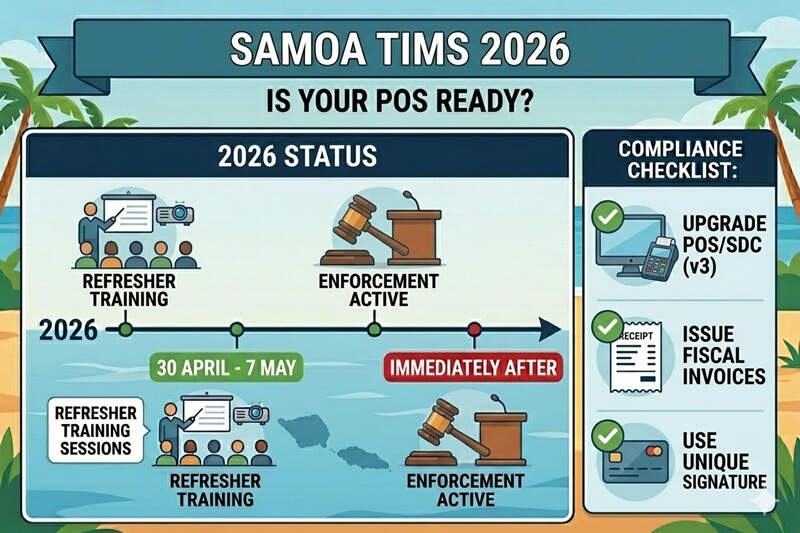
Samoa’s Tax Invoice Monitoring System (TIMS) is entering an important compliance phase in 2026. The Ministry of Revenue has announced refresher training for taxpayers already registered on TIMS, together with a recent system upgrade and stronger enforcement for businesses that are not issuing fiscal invoices.
For business owners, accountants, retailers, restaurants, hotels, service companies, and POS vendors in Samoa, this is the right time to review one question:
Is your POS, accounting software, or invoicing workflow ready for TIMS compliance?
This guide explains what the 2026 TIMS training means, why the v3 upgrade matters, and how businesses can prepare their POS, SDC, or accounting integration before compliance issues appear.
TL;DR / Summary
Samoa TIMS is moving into a stronger compliance and enforcement stage in 2026.
- TIMS refresher training is scheduled from 30 April to 7 May 2026.
- The training introduces the recent TIMS system upgrade.
- Taxpayers are expected to understand how the upgraded system affects fiscal invoice issuing.
- The Ministry has announced enforcement actions and penalties for taxpayers not issuing fiscal invoices.
- Businesses using POS systems should check whether their POS and SDC setup is ready for TIMS v3.
- Businesses using Xero or other accounting software may need an integration layer to connect their invoice workflow with TIMS.
- External SDC setups are important for businesses that need offline fiscal invoicing continuity.
Table of contents
- What is changing with Samoa TIMS in 2026?
- Who should pay attention to TIMS training?
- How do I make my POS system TIMS compliant in Samoa?
- Do Samoa businesses need to upgrade to TIMS v3?
- What does it mean to issue fiscal invoices in Samoa?
- Can my business keep issuing invoices when TIMS is offline?
- Can Xero or accounting software connect to TIMS?
- TIMS compliance checklist for Samoa businesses
- TIMS checklist for POS vendors and software providers
- How FiscoBridge can help
- Frequently asked questions
What is changing with Samoa TIMS in 2026?
In 2026, Samoa’s Ministry of Revenue announced refresher training for taxpayers registered on the Tax Invoice Monitoring System.
The training is important because it is not only a general reminder. It also introduces the recent TIMS system upgrade, which is designed to improve efficiency, compliance, and user experience.
The same public notice also confirms that enforcement is becoming more serious. Taxpayers that are not issuing fiscal invoices may face penalties and other compliance actions.
For businesses, the message is clear:
- Understand the upgraded TIMS system.
- Check whether your POS or invoicing software is still compatible.
- Make sure your business can issue fiscal invoices correctly.
- Do not wait for another extension.
Who should pay attention to TIMS training?
TIMS training is especially relevant for taxpayers already registered on the Tax Invoice Monitoring System.
It is also important for any business in Samoa that depends on software to issue invoices or receipts, including:
- Retail shops
- Supermarkets and wholesalers
- Restaurants, cafés, and bars
- Hotels and accommodation providers
- Service companies
- Businesses using cloud accounting software
- Businesses with multiple branches or terminals
- POS vendors and software developers serving Samoa clients
If your business issues invoices or receipts through a POS, ERP, accounting system, or custom software, you should review your TIMS compliance setup.
How do I make my POS system TIMS compliant in Samoa?
A POS system becomes TIMS compliant when it can issue fiscal invoices through the required fiscalization workflow.
For many businesses, the POS is only the first part of the process. The POS creates the sale, but TIMS compliance requires the transaction to be processed through approved fiscal components before the customer receives a valid fiscal invoice.
A typical TIMS-compliant POS workflow looks like this:
- The cashier or user creates a sale in the POS.
- The POS sends invoice data to the fiscalization layer.
- The Sales Data Controller processes and signs the invoice data.
- The invoice receives fiscal information required by TIMS.
- The POS prints or sends the fiscal invoice to the customer.
- The fiscal data is stored and transmitted according to TIMS requirements.
If your POS cannot connect to a TIMS-compatible fiscalization layer, it may need an integration, upgrade, or replacement.
FiscoBridge SDC is designed for POS vendors and businesses that need a stable fiscalization layer between their POS software and Pacific tax authority systems. You can learn more here: FiscoBridge SDC.
Do Samoa businesses need to upgrade to TIMS v3?
Samoa’s TIMS system has been upgraded from Version 2 to Version 3.
This matters because older POS and SDC implementations may not remain suitable for the upgraded system without testing or changes.
Businesses should ask their POS provider:
- Is our POS ready for TIMS v3?
- Is our SDC compatible with the upgraded TIMS system?
- Has the solution been tested against the v3 environment?
- Does the system support the invoice types and workflows we use every day?
- Can the system continue operating if the internet connection is unstable?
POS vendors should not treat TIMS v3 as a small technical update. Version upgrades can affect endpoints, validation rules, invoice processing, error handling, and accreditation readiness.
If you are a POS vendor preparing for Samoa TIMS v3, FiscoBridge provides POS-to-SDC integration guidance here: POS to SDC Protocol.
What does it mean to issue fiscal invoices in Samoa?
Issuing a normal receipt is not always the same as issuing a fiscal invoice.
For TIMS compliance, the invoice must be processed through the required fiscalization system and contain the fiscal information required by the tax authority.
A Samoa business should check whether its invoice workflow can:
- Create invoice data in the correct structure.
- Send the invoice to the fiscalization layer.
- Receive fiscal invoice data back from the SDC or integration service.
- Print or display the required fiscal details on the customer invoice.
- Store fiscal invoice history for reporting and audit needs.
- Handle corrections, cancellations, and common cashier errors correctly.
This is why many businesses need more than a simple POS receipt printer. They need a complete fiscal invoice workflow.
Can my business keep issuing invoices when TIMS is offline?
Offline continuity is one of the most important practical questions for Samoa businesses.
Samoa’s official TIMS upgrade notice explains that accredited POS systems using a Virtual SDC may not function during certain interruptions, while POS systems using an External SDC can continue to operate offline without interruption.
This is especially important for businesses that cannot stop selling when the internet is unstable, including:
- Retail shops with constant customer traffic
- Restaurants and cafés during busy hours
- Hotels and tourism operators
- Remote or island locations with unstable connectivity
- Businesses with multiple POS terminals
If your business needs to keep issuing invoices even during internet or server interruptions, you should discuss an External SDC setup with your POS provider.
FiscoBridge SDC is built for local fiscalization workflows where businesses need reliable invoice issuing and offline-capable operation. See: FiscoBridge SDC.
Can Xero or accounting software connect to TIMS?
Many Samoa businesses use accounting software such as Xero or other cloud systems to manage invoices, payments, and bookkeeping.
The important point is that accounting software usually does not connect directly to TIMS by itself. Businesses often need an integration layer that connects the accounting workflow with the fiscalization system.
A common accounting integration workflow can look like this:
- The business creates or approves an invoice in the accounting system.
- The integration detects the invoice or payment event.
- The invoice data is sent for fiscalization.
- The fiscal invoice or journal data is generated.
- The fiscal document or verification details are attached back to the accounting record.
This allows the business to keep using its existing accounting workflow while adding the fiscalization layer required for compliance.
If your business uses Xero or another accounting system, review FiscoBridge integration options here: FiscoBridge Integrations.
Which Samoa businesses should consider Web Invoicing for TIMS?
Some businesses do not have a complex POS or ERP system. They only need a simple way to issue compliant invoices without managing a large software project.
Web Invoicing may be suitable for:
- Small service businesses
- Low-volume businesses with simple invoice requirements
- Businesses without an existing POS
- Companies that want a lightweight invoicing workflow
- Businesses that do not want to build a custom integration
FiscoBridge Web Invoicing is designed for businesses that need a simple browser-based invoicing workflow with fiscal compliance support. Learn more here: FiscoBridge Web Invoicing.
Businesses that need a complete POS for retail, restaurant, café, hotel, inventory, staff, and reporting workflows can review FiscoBridge Desktop POS.
TIMS compliance checklist for Samoa businesses
Samoa businesses can use this checklist to prepare for TIMS training, system upgrades, and fiscal invoice compliance.
- Confirm your TIMS status: check whether your business is registered and expected to issue fiscal invoices.
- Attend the 2026 TIMS refresher training: use the training to understand the upgraded system and compliance expectations.
- Review your current POS: confirm whether it supports TIMS fiscal invoice workflows.
- Ask about TIMS v3 compatibility: verify that your POS and SDC are ready for the upgraded system.
- Check offline operation: confirm whether your system can continue issuing invoices during internet or service interruptions.
- Review invoice printing: make sure receipts and invoices contain the required fiscal details.
- Check cancellation and correction flows: staff must know how to handle mistakes correctly.
- Train cashiers and finance staff: compliance depends on daily usage, not only software installation.
- Keep fiscal invoice records: maintain invoice history for reporting, review, and audit support.
- Plan upgrades early: do not wait until enforcement causes operational pressure.
TIMS checklist for POS vendors and software providers
POS vendors serving Samoa clients should treat TIMS v3 as a compliance project, not only a software patch.
Before offering a solution to taxpayers, vendors should confirm:
- The POS can send invoice data in the required structure.
- The POS can communicate with a compliant SDC or fiscalization layer.
- The solution has been tested for TIMS v3 compatibility.
- The system handles successful and failed fiscalization responses correctly.
- The POS can print or display fiscal invoice data correctly.
- The solution supports common business workflows such as refunds, cancellations, and branch operations.
- The vendor has a clear support process for taxpayers during rollout.
Vendors that do not want to build and maintain the full fiscalization layer can integrate their POS with FiscoBridge SDC instead.
Start with the technical guide: POS to SDC Protocol.
How FiscoBridge can help with Samoa TIMS compliance
FiscoBridge helps businesses, POS vendors, and accounting software users connect their invoice workflows with fiscalization systems across the Pacific region, including Samoa TIMS.
Depending on your setup, FiscoBridge can help with:
- FiscoBridge SDC for businesses and POS vendors that need a fiscalization layer.
- FiscoBridge Web Invoicing for businesses that need a simple browser-based invoicing workflow.
- FiscoBridge Desktop POS for retail shops, restaurants, cafés, hotels, and other businesses that need a complete POS with inventory, staff controls, and reporting.
- FiscoBridge Integrations for accounting systems, ERP systems, and custom invoice workflows.
- POS to SDC API integration for software vendors.
This gives businesses flexibility. You do not always need to replace your full system. In many cases, the better path is to connect your existing POS, accounting software, or ERP to a compliant fiscalization layer.
Best solution by business situation
| Business situation | Recommended path | FiscoBridge option |
|---|---|---|
| You already have a POS system | Connect your POS to an SDC | FiscoBridge SDC |
| You are a POS vendor serving Samoa clients | Integrate your POS with a fiscalization layer | POS to SDC Protocol |
| You use Xero or accounting software | Use an accounting-to-fiscalization integration | FiscoBridge Integrations |
| You need simple browser-based invoicing | Use a lightweight web invoicing workflow | FiscoBridge Web Invoicing |
| You need a complete POS | Use a system for sales, inventory, staff controls, and reporting | FiscoBridge Desktop POS |
| You are not sure which option fits | Review your workflow first | FiscoBridge Solution Checker |
Frequently asked questions
How do I make my business TIMS compliant in Samoa?
To make your business TIMS compliant, you need a workflow that can issue fiscal invoices through a TIMS-compatible POS, SDC, or integration layer. Registration alone is not enough if your daily invoice process cannot produce fiscal invoices correctly.
What should I ask my POS provider after the Samoa TIMS 2026 training notice?
Ask whether your POS is ready for TIMS v3, whether it works with a compliant SDC, whether it can issue fiscal invoices, and whether it can continue operating during internet or TIMS service interruptions.
Do I need to replace my POS system for TIMS compliance?
Not always. If your existing POS can integrate with a compliant SDC or fiscalization layer, you may be able to keep your current POS and add the required compliance connection.
Can a Samoa business use Xero and still comply with TIMS?
Yes, but Xero usually needs an integration layer to connect invoice or payment data with the fiscalization process required by TIMS. FiscoBridge Integrations can help businesses connect accounting software with fiscal compliance workflows.
What is the difference between V-SDC and E-SDC for Samoa TIMS?
The practical difference is continuity. A Virtual SDC may depend more heavily on online availability, while an External SDC can support offline operation when properly configured. This matters for businesses that cannot stop issuing invoices during outages or unstable internet conditions.
Why is offline fiscal invoicing important in Samoa?
Offline fiscal invoicing is important because many businesses cannot pause sales when there is an internet problem, server downtime, or service interruption. A setup with offline-capable SDC support can reduce business disruption.
What is the best TIMS solution for a small business in Samoa?
If the business only needs simple browser-based invoicing, FiscoBridge Web Invoicing may be the easiest path. If it needs a complete POS for retail, restaurant, café, hotel, inventory, staff, and reporting operations, FiscoBridge Desktop POS may be more suitable. If the business already has a POS, connecting it to an SDC may be better. If the business uses accounting software, an integration may be the right option.
What is the best TIMS solution for POS vendors in Samoa?
POS vendors should either build full TIMS fiscalization support or connect their POS software to a compliant SDC. Integrating with an existing SDC can reduce development time, testing risk, and long-term maintenance work.
What happens if a Samoa taxpayer does not issue fiscal invoices?
The Ministry has stated that penalties and other enforcement actions will begin for taxpayers not issuing fiscal invoices. Businesses should use the 2026 training and system upgrade period to correct their invoice workflow before compliance problems occur.
Final thoughts
Samoa TIMS 2026 training is more than a refresher session. It is a signal that taxpayers should review their fiscal invoice workflow, understand the upgraded TIMS system, and prepare for stronger enforcement.
The most important question for every business is simple:
Can your current POS, accounting software, or invoicing system issue TIMS-compliant fiscal invoices every day?
If the answer is not clear, now is the right time to review your setup.
Need help choosing the right TIMS compliance path?
Explore FiscoBridge SDC, Web Invoicing, Desktop POS, or Integrations.