
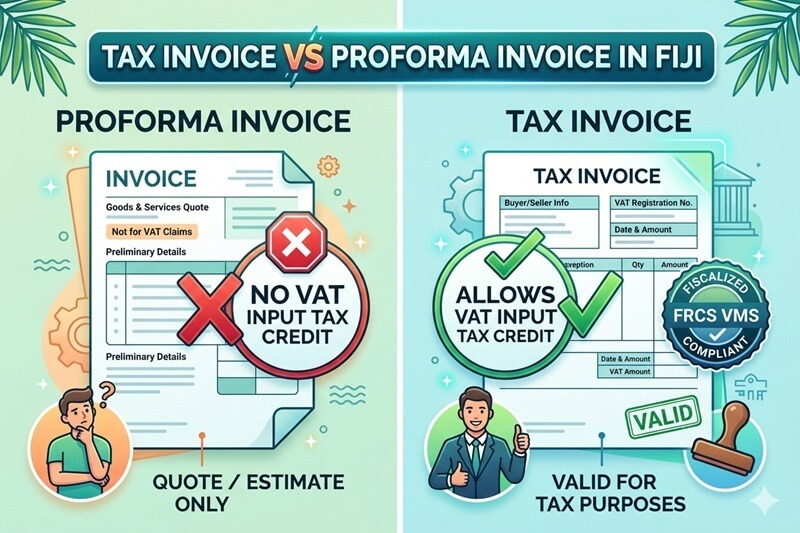
Many businesses in Fiji use quotes, proforma invoices, receipts, accounting invoices, and fiscal invoices in their daily work. But for VAT input tax credit claims, the difference between a Tax Invoice and a Proforma Invoice is very important.
FRCS has clarified that only a valid Tax Invoice issued by a VAT-registered supplier can be used as the basis for claiming VAT input tax credits. A Proforma Invoice should not be used for VAT input claims.
This matters even more as Fiji continues the VMS Phase 3 rollout, where businesses need proper fiscal invoice workflows through an accredited POS, SDC, Web Invoicing, Desktop POS, or integration solution.
TL;DR / Summary
- A Tax Invoice is used for actual taxable sales and can support VAT input tax credit claims if it meets FRCS requirements.
- A Proforma Invoice is usually a preliminary document, quote, or request for payment before the actual taxable supply is completed.
- FRCS says Proforma Invoices should not be submitted for VAT input tax credit claims.
- For Fiji VMS, Proforma, Copy, and Training invoice types must clearly show that they are not fiscal invoices.
- Businesses using POS, Xero, ERP, or accounting software should make sure their invoice workflow can issue proper fiscalized Tax Invoices.
- FiscoBridge can help with SDC, Web Invoicing, Desktop POS, and accounting or ERP integrations.
Table of contents
- Why this matters for Fiji businesses
- Can I claim VAT input tax credit from a Proforma Invoice in Fiji?
- What invoice do I need to claim VAT input tax credit in Fiji?
- When should a Fiji business use a Proforma Invoice?
- How does this connect to Fiji VMS fiscalization?
- What should Xero and accounting software users check?
- What should POS vendors check?
- Tax Invoice and Proforma Invoice compliance checklist
- How FiscoBridge can help
- Frequently asked questions
Why this matters for Fiji businesses
For VAT-registered businesses in Fiji, invoice type is not just an accounting detail. It can affect VAT claims, audit readiness, customer trust, and VMS compliance.
The risk is simple:
- A customer may receive a Proforma Invoice and treat it like a Tax Invoice.
- An accounts team may use the wrong document for VAT input tax credit claims.
- A POS or accounting system may not clearly separate proforma, normal sale, copy, refund, and training invoice types.
- A business may issue documents that look similar but have different tax meaning.
This is why businesses should make sure their invoicing system clearly separates quote-style documents from valid fiscalized Tax Invoices.
Can I claim VAT input tax credit from a Proforma Invoice in Fiji?
No. A Proforma Invoice should not be used to claim VAT input tax credits in Fiji.
FRCS has clarified that only a Tax Invoice issued by a VAT-registered person qualifies for input tax credit claims. A Proforma Invoice is not the same as a Tax Invoice and should not be submitted for VAT input claims.
This is one of the most important practical rules for Fiji businesses:
- Use a Tax Invoice for VAT input tax credit claims.
- Do not use a Proforma Invoice as proof for VAT input tax credit claims.
- Make sure the supplier is VAT registered.
- Make sure the invoice contains the required tax information.
What invoice do I need to claim VAT input tax credit in Fiji?
A VAT-registered business generally needs a valid Tax Invoice from a VAT-registered supplier to claim VAT input tax credits.
For practical business workflows, this means your finance team should check:
- Is the supplier VAT registered?
- Is the document clearly a Tax Invoice?
- Does the invoice contain the required supplier and tax details?
- Is the invoice related to goods or services used for business purposes?
- Is the invoice stored properly for VAT return and audit purposes?
For businesses using VMS-compatible systems, the goal should be to issue and store fiscalized invoices correctly from the start, rather than correcting invoice records later.
When should a Fiji business use a Proforma Invoice?
A Proforma Invoice can still be useful, but it should be used for the right purpose.
Businesses often use Proforma Invoices for:
- Price estimates
- Preliminary sales documents
- Requests for payment before final supply
- Import/export preparation
- Customer approval before issuing a final invoice
The important point is that a Proforma Invoice should be clearly labelled and should not be treated as the final Tax Invoice for VAT input tax credit claims.
How does this connect to Fiji VMS fiscalization?
Fiji VMS fiscalization adds another layer of importance to invoice type.
In a fiscalized POS or SDC workflow, the invoice type matters because the system must correctly identify whether the transaction is a normal sale, refund, copy, proforma, or training invoice.
For VMS fiscal invoices, the POS and SDC workflow should correctly handle:
- Normal Sale invoices
- Normal Refund invoices
- Copy invoices
- Proforma invoices
- Training invoices
- Invoice references for refunds or copies
- Required fiscal metadata
- QR code or verification URL requirements
FRCS VMS guidance explains that Proforma, Copy, and Training invoice types must display the message that they are not fiscal invoices. This helps prevent confusion between a valid fiscal invoice and a document that should not be used as one.
If your existing POS cannot correctly separate these invoice types, you may need to upgrade it or connect it to a compliant fiscalization layer. FiscoBridge SDC can help with this workflow: FiscoBridge SDC.
What should Xero and accounting software users check?
Many Fiji businesses use Xero, ERP systems, or other accounting software to create invoices and track payments. The main question is whether the accounting workflow can produce the correct fiscalized output for VMS compliance.
Businesses using accounting software should ask:
- When is the invoice considered final?
- Does the system create draft, proforma, approved, and paid invoice states?
- Which invoice state should trigger fiscalization?
- Can the fiscalized document be attached back to the accounting invoice?
- Can the finance team easily identify which invoices are valid Tax Invoices?
- Can the system prevent a Proforma Invoice from being used as a VAT claim document?
This is especially important for businesses that issue invoices before payment, after payment, or through approval workflows.
FiscoBridge provides integration options for businesses that need to connect accounting systems with fiscalization workflows: FiscoBridge Integrations.
Can Web Invoicing help small businesses avoid invoice confusion?
Yes. For small businesses that do not already have a complex POS or ERP system, simple Web Invoicing can reduce confusion by keeping invoice types and fiscalization flows clear.
A good Web Invoicing workflow should help the business:
- Create sales invoices in the correct format.
- Separate proforma and final invoice workflows.
- Send final invoice data for fiscalization.
- Store fiscal invoice history.
- Print or share the correct invoice with the customer.
FiscoBridge Web Invoicing is designed for businesses that need a simple browser-based invoicing workflow with fiscal compliance support: FiscoBridge Web Invoicing.
What should POS vendors check?
POS vendors serving Fiji businesses should make sure their software handles invoice types correctly. This is not only a user interface issue. It affects fiscalization, reporting, and customer documents.
POS vendors should check:
- Does the POS clearly separate Normal Sale, Refund, Copy, Proforma, and Training invoice types?
- Does the POS send the correct invoice type to the SDC?
- Does the POS display and print the correct fiscal invoice data?
- Does the POS show required messages for non-fiscal invoice types?
- Does the POS handle B2B buyer details correctly?
- Does the POS store fiscalized invoice results for audit and reporting?
- Does the POS prevent staff from confusing quotes or proforma documents with final fiscal invoices?
POS vendors that want to integrate with FiscoBridge can review the technical guide here: POS to SDC Protocol.
Tax Invoice and Proforma Invoice compliance checklist
Fiji businesses can use this checklist to reduce invoice mistakes and VAT claim issues.
- Check the document title: confirm whether the document is a Tax Invoice or Proforma Invoice.
- Confirm VAT registration: check that the supplier is VAT registered before claiming input tax credits.
- Do not claim VAT from proforma documents: use valid Tax Invoices for VAT input tax credit claims.
- Review POS settings: make sure invoice types are mapped correctly in the POS.
- Review accounting workflows: confirm when invoices become final and when fiscalization should happen.
- Check fiscal invoice output: make sure fiscal invoices include required fiscal information.
- Train staff: cashiers and finance teams should understand the difference between proforma and tax invoices.
- Store invoice records: keep invoices and fiscal records for VAT return and audit support.
- Use accredited tools: make sure your POS, SDC, or integration supports Fiji VMS requirements.
How FiscoBridge can help
FiscoBridge helps Fiji businesses, POS vendors, and accounting software users create practical fiscalization workflows for VMS compliance.
Depending on your setup, FiscoBridge can support:
- FiscoBridge SDC for businesses and POS vendors that need a fiscalization layer.
- FiscoBridge Web Invoicing for businesses that need a simple browser-based invoicing solution.
- FiscoBridge Desktop POS for retail shops, restaurants, cafés, hotels, and other businesses that need a complete POS with inventory, staff controls, and reporting.
- FiscoBridge Integrations for accounting software, ERP systems, and custom invoice workflows.
- POS to SDC Protocol for software vendors that want to connect their POS with FiscoBridge SDC.
The goal is simple: keep your existing workflow where possible, but make sure final invoices are fiscalized correctly and clearly separated from proforma or draft documents.
Best solution by business situation
| Business situation | Main risk | FiscoBridge option |
|---|---|---|
| You already use a POS | POS may not handle VMS invoice types correctly | FiscoBridge SDC |
| You use Xero or accounting software | Draft, proforma, approved, and paid invoices may need fiscalization rules | FiscoBridge Integrations |
| You need a simple invoicing system | Manual invoices can cause VAT claim and document confusion | FiscoBridge Web Invoicing |
| You need a complete POS system | Your business needs sales processing, inventory, staff controls, and reporting together with fiscal compliance | FiscoBridge Desktop POS |
| You are a POS vendor | Invoice type mapping and fiscal output must be correct | POS to SDC Protocol |
Frequently asked questions
Can I claim VAT input tax credit from a Proforma Invoice in Fiji?
No. FRCS has clarified that Proforma Invoices should not be submitted for VAT input tax credit claims. A VAT input tax credit claim should be supported by a valid Tax Invoice issued by a VAT-registered supplier.
What invoice do I need for VAT input tax credit claims in Fiji?
You need a valid Tax Invoice from a VAT-registered supplier. The invoice should meet the required VAT invoice requirements and should be kept as part of your business records.
Is a Proforma Invoice the same as a Tax Invoice?
No. A Proforma Invoice is usually a preliminary document, quote, or request for payment. It should not be treated as the final Tax Invoice for VAT input tax credit claims.
Why does my Fiji invoice say “This is not a fiscal invoice”?
In Fiji VMS workflows, certain invoice types such as Proforma, Copy, and Training invoices must clearly show that they are not fiscal invoices. This helps prevent customers and accounting teams from treating the wrong document as a valid fiscal invoice.
Can a POS issue a Proforma Invoice under Fiji VMS?
Yes, POS systems can support Proforma invoice workflows, but the document must be treated correctly. A Proforma Invoice should not be used as a valid Tax Invoice for VAT input tax credit claims.
What should I check before claiming VAT on supplier invoices in Fiji?
Check that the supplier is VAT registered, the document is a Tax Invoice, the invoice contains the required tax information, and the purchase is related to your business activity. Do not use Proforma Invoices for VAT input claims.
How can Xero users in Fiji avoid Tax Invoice and Proforma Invoice mistakes?
Xero users should define when an invoice becomes final and when fiscalization should happen. They should also make sure fiscalized documents are attached back to the accounting invoice and that proforma or draft documents are not used for VAT input tax credit claims.
Do POS vendors need to support different invoice types for Fiji VMS?
Yes. POS vendors should correctly support invoice types such as Normal Sale, Refund, Copy, Proforma, and Training. The POS should send the correct invoice type to the SDC and display the correct fiscal or non-fiscal message to the customer.
Final thoughts
The difference between a Tax Invoice and a Proforma Invoice is not only a wording issue. In Fiji, it can affect VAT input tax credit claims, audit readiness, and VMS fiscalization compliance.
Businesses should make sure their POS, accounting software, or ERP system clearly separates proforma documents from valid fiscalized Tax Invoices.
If your business is not sure whether your current invoice workflow is ready for Fiji VMS, FiscoBridge can help you review the best path.
Explore FiscoBridge SDC, Web Invoicing, Desktop POS, or Integrations.