
FRCS has confirmed the Electronic Fiscal Device (EFD) Phase 3 timelines. For Accommodation Group 2, the official notice lists the registration due date as 30 June 2026 and the implementation due date as 30 September 2026.
This means accommodation businesses should not wait until the final month to check their POS, hotel POS software, restaurant POS, PMS, Cloudbeds, Xero, accounting software, SDC, Secure Element, and VMS V3 readiness.
Hotels and resorts often have more complex sales flows than simple retail shops. A single guest account may include room charges, restaurant bills, bar sales, spa services, tours, deposits, refunds, no-shows, service charges, and accounting software posting.
If your hotel or resort uses Xero, FiscoBridge has a solution to help connect Xero invoices to Fiji VMS fiscalization. If your accommodation business uses Cloudbeds, FiscoBridge also has a Cloudbeds integration path to support hotel invoice and guest billing workflows where supported.
Because of that, Fiji VMS compliance should be planned early, especially if your hotel, resort, restaurant, PMS, POS, or accounting workflow needs to keep running without invoice disruption.
TL;DR / Summary
- Accommodation Group 2 registration due date: 30 June 2026, according to the FRCS public notice.
- Accommodation Group 2 implementation due date: 30 September 2026, according to the FRCS public notice.
- Accommodation businesses should check whether their hotel POS, restaurant POS, PMS, Cloudbeds, Xero, ERP, or accounting system can issue VMS fiscal invoices.
- If your Fiji hotel or resort uses Xero, FiscoBridge has a solution to help connect Xero invoices to VMS fiscalization.
- If your hotel or resort uses Cloudbeds, FiscoBridge has a Cloudbeds integration path to support hotel invoice and guest billing fiscalization workflows where supported.
- For Fiji VMS V3, businesses should understand the role of the POS, SDC, Secure Element, EFD, fiscal invoice, and V3 Accreditation List.
- Hotels and resorts may not need to replace the whole POS if the existing POS can connect to a compliant SDC.
- FiscoBridge SDC can act as the fiscalization layer between the POS and the tax authority system.
- FiscoBridge Web Invoicing can support businesses that need a simple, ready-to-use browser invoicing option.
- FiscoBridge Integrations can help businesses using Xero, Cloudbeds, accounting software, ERP, PMS, or custom systems.
- FiscoBridge Desktop POS is available for hotels, restaurants, cafés, retail outlets, and other hospitality businesses that need a complete sales and operations solution.
Table of contents
- What is the Fiji VMS deadline for Accommodation Group 2?
- Which hotels and resorts should check VMS readiness?
- What should hotel POS and restaurant POS systems support?
- What if a hotel uses Xero or Cloudbeds?
- Can hotels keep their existing POS?
- What does the SDC do in Fiji VMS?
- Can Xero, Cloudbeds, PMS, or accounting software connect to Fiji VMS?
- Do hotels need to move to VMS V3?
- What should hotels prepare before implementation?
- Checklist
- How FiscoBridge can help
- Best solution by business situation
- Frequently asked questions
What is the Fiji VMS deadline for Accommodation Group 2?
The FRCS public notice for EFD Phase 3 timelines lists Accommodation Group 2 with the following dates:
| Business group | Registration due | Implementation due |
|---|---|---|
| Accommodation Group 2 | 30 June 2026 | 30 September 2026 |
Hotels, resorts, lodges, apartments, villas, and other accommodation operators should check the official FRCS notice and Gazette Notice 61 of 2025 to confirm whether their business falls under this group.
The implementation date is especially important because it is the date by which the business should be ready to issue fiscal invoices through the required Fiji VMS process, based on the applicable FRCS requirements.
Which hotels and resorts should check VMS readiness?
Accommodation businesses should review their VMS readiness if they issue invoices, receipts, tax invoices, or guest bills through any of these systems:
- Hotel POS software
- Restaurant POS software
- Resort POS system
- Property Management System (PMS)
- Cloudbeds
- Xero
- Booking or reservation system
- Cloud accounting software
- ERP system
- Custom invoicing software
- Manual invoice process
This is important for hotels and resorts because the final guest invoice may combine several revenue sources. For example, one guest bill may include room charges, restaurant meals, minibar, spa, tours, transfers, and other services.
If these sales are not fiscalized correctly, the business may face invoice disruption, operational delays, and customer issues around fiscal invoice records or VAT input tax credit support.
What should hotel POS and restaurant POS systems support?
A hotel POS or restaurant POS system used in Fiji should be checked for VMS compatibility before the implementation deadline.
For accommodation businesses, the POS, PMS, Cloudbeds, Xero, or accounting process should be able to support:
- Fiscal invoice creation
- Tax Invoice handling
- Correct VAT calculation and invoice data transfer
- Connection to an SDC where required
- Secure Element usage where required
- Refunds, cancellations, and corrections
- Room charges and restaurant charges
- Multiple outlets such as front desk, restaurant, bar, spa, and gift shop
- Offline or unstable internet situations, depending on the selected solution
- Reporting and storage according to fiscalization requirements
Searches such as hotel POS Fiji, restaurant POS Fiji, resort POS software Fiji, hospitality POS Fiji, VMS compliant POS for hotels, Cloudbeds Fiji VMS integration, Xero Fiji VMS integration, and Fiji hotel fiscalization software usually have the same business question behind them: “Which system can help us issue compliant fiscal invoices without breaking daily operations?”
FiscoBridge Desktop POS is available for hotels, restaurants, cafés, retail outlets, and other hospitality businesses. It provides a complete POS option for businesses that need sales processing, inventory, staff controls, reporting, and fiscal compliance in one system.
What if a hotel uses Xero or Cloudbeds?
Many hotels and resorts do not rely on only one system. A hotel may use Cloudbeds for reservations, guest profiles, room charges, and property management, while using Xero for accounting, bookkeeping, reporting, and invoicing.
Before choosing a Fiji VMS solution, the business should confirm where the customer invoice or final guest bill is created.
If your hotel or resort creates invoices in Xero, FiscoBridge has a solution to help connect Xero invoices to Fiji VMS fiscalization. This can help the business keep its accounting workflow while adding the required fiscalization step.
If your hotel or resort uses Cloudbeds, FiscoBridge has a Cloudbeds integration path that can help connect hotel invoices, guest bills, and accommodation-related sales to the Fiji VMS fiscalization workflow where supported.
This is useful for accommodation businesses that need to handle:
- Room charges
- Guest invoices
- Deposits and advance payments
- Restaurant or bar charges
- Accommodation packages
- Service charges
- Refunds and corrections
- Accounting sync to Xero
The correct setup depends on the real invoice flow. Some hotels may need Xero integration, some may need Cloudbeds integration, and some may need a custom workflow that connects PMS, POS, restaurant sales, and accounting data correctly.
Can hotels keep their existing POS?
In many cases, a business may not need to replace its whole POS if the existing POS can connect to a compliant SDC.
This is important for hotels and resorts that already use a PMS, Cloudbeds, restaurant POS, Xero, or accounting system. Replacing the full system can be expensive and risky, especially when staff already depend on it for front desk, reservations, restaurant, bar, and back-office operations.
The better first question is:
Can the existing POS, PMS, Cloudbeds, Xero, ERP, or accounting system send invoice data to a compliant fiscalization layer?
If the answer is yes, the business may be able to keep the existing system and connect it to an SDC or integration. If the answer is no, the business may need Web Invoicing, Desktop POS, or a custom integration.
Businesses can also use the FiscoBridge Solution Checker to help understand which option may fit their situation.
What does the SDC do in Fiji VMS?
The SDC is an important part of the Fiji VMS fiscalization workflow.
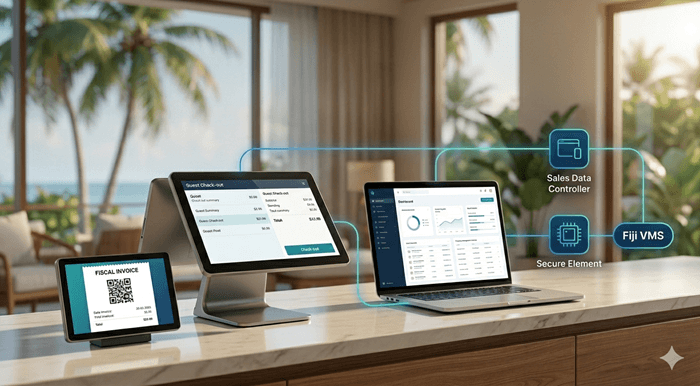
The POS creates the sale or invoice, while the SDC performs the fiscalization layer. It receives invoice data from the POS, works with the Secure Element to sign the invoice, returns fiscal invoice data back to the POS, and supports storage/reporting according to fiscalization requirements.
This means the POS and SDC should work together correctly. The POS should not only print a normal receipt. It should receive and show the correct fiscal invoice data returned from the fiscalization process.
For hotels and resorts, this matters because different parts of the business may issue invoices in different ways:
- Front desk may issue room invoices.
- Cloudbeds may manage reservations, guest bills, and accommodation charges.
- Restaurant POS may issue meal bills.
- Bar POS may issue separate receipts.
- Xero or another accounting system may issue Tax Invoices.
- Back office may need daily and monthly reporting.
FiscoBridge SDC is designed to support this fiscalization layer for businesses that already have a POS or software system that can connect to an SDC.
Can Xero, Cloudbeds, PMS, or accounting software connect to Fiji VMS?
Yes, integration may be possible depending on the system and the invoice flow.
Many hotels and resorts use Cloudbeds or another PMS for daily guest operations and then sync data to Xero or another accounting system. Other businesses create invoices directly in Xero.
Before choosing a VMS solution, accommodation businesses should check where the legal invoice is created:
- Is the guest invoice created in Cloudbeds?
- Is the guest invoice created in another PMS?
- Is the restaurant invoice created in the restaurant POS?
- Is the Tax Invoice created in Xero or accounting software?
- Are invoices only summarized in accounting software after payment?
- Are deposits, refunds, and corrections handled in the same system?
If the business uses Xero, Cloudbeds, ERP, accounting software, PMS, or a custom system, FiscoBridge Integrations can help connect the invoice workflow to fiscalization where supported.
For POS vendors and software developers, the FiscoBridge POS to SDC Protocol explains how a POS can communicate with the FiscoBridge SDC.
Do hotels need to move to VMS V3?
FRCS explains that Phase 3 businesses as per Gazette Notice 61 of 2025 are required to register on Version 3.0 in line with the registration and implementation timelines.
FRCS also explains that VMS Version 2.0 will cease by 31 December 2026. Businesses should check their current setup against the official FRCS guidance, especially if they previously used a VMS V2 setup or an older fiscal card.
Accommodation businesses should confirm:
- Whether they are under Accommodation Group 1 or Accommodation Group 2
- Whether they need VMS V3 registration
- Whether they have the correct Secure Element
- Whether their POS is compatible with the selected SDC
- Whether Cloudbeds, Xero, PMS, or accounting software needs an integration
- Whether their provider appears on the relevant V3 Accreditation List where applicable
- Whether any V2 setup needs to be upgraded before it creates invoice disruption
This should be checked early, because a hotel cannot easily stop invoicing guests while waiting for software changes, vendor updates, staff training, or Secure Element setup.
What should hotels prepare before implementation?
Hotels and resorts should treat VMS implementation as an operational project, not only a software setting.
The business should map all places where sales are created:
- Reception and front desk
- Cloudbeds or PMS
- Xero or accounting software
- Restaurant
- Bar
- Café
- Room service
- Spa or wellness centre
- Tour desk
- Gift shop or retail area
- Events, weddings, and conferences
- Accounting or back office
Then the business should decide whether each sales point needs to issue a fiscal invoice directly, or whether invoices are centralized through one system.
This is also the right time to review invoice wording, Tax Invoice format, Proforma Invoice process, VAT handling, and whether customers need fiscal invoice documents for VAT input tax credit support.
Checklist
Accommodation Group 2 businesses can use this checklist before the 30 September 2026 implementation date:
- Confirm whether the business is listed under Accommodation Group 2 or another group in the official FRCS guidance.
- Confirm the registration due date and implementation due date with FRCS or your tax adviser.
- Check whether your hotel POS, restaurant POS, PMS, Cloudbeds, Xero, ERP, or accounting software can connect to fiscalization.
- Check whether your current POS is VMS V3 ready.
- Check whether your current setup depends on VMS V2 and whether an upgrade is required.
- Confirm Secure Element requirements and timing.
- Confirm whether each outlet, property, branch, or business location needs a separate setup.
- Confirm whether Xero invoices should be fiscalized on approval, payment, or another business event.
- Confirm whether Cloudbeds guest invoices or PMS bills are the correct source for fiscalization.
- Test normal sales, Tax Invoices, refunds, cancellations, and correction flows.
- Test restaurant bills, room charges, split payments, deposits, and guest account posting.
- Check how fiscal invoice data is printed, emailed, or attached back to the original invoice.
- Train front desk, restaurant, accounting, and management teams.
- Prepare a fallback process for internet issues, device issues, or staff mistakes.
- Keep official FRCS source links and vendor support contacts available.
How FiscoBridge can help
FiscoBridge provides fiscalization solutions for Fiji, Samoa, and Vanuatu, including Fiji VMS, Samoa TIMS, and Vanuatu VSMS workflows.
For Fiji accommodation businesses, FiscoBridge can support different situations:
- FiscoBridge SDC for businesses that have an existing POS and need a fiscalization layer.
- FiscoBridge Web Invoicing for businesses that need a simple browser-based invoicing option without a complex existing POS.
- FiscoBridge Desktop POS for hotels, restaurants, cafés, retail outlets, and other businesses that need a complete POS with inventory, staff controls, and reporting.
- FiscoBridge Integrations for Xero, Cloudbeds, ERP, accounting software, PMS, or custom invoice workflows.
- POS to SDC Protocol for POS vendors and software developers that want to connect their POS to FiscoBridge SDC.
- Solution Checker for businesses that are not sure whether they need Desktop POS, SDC, Web Invoicing, Xero integration, Cloudbeds integration, or a custom setup.
If your hotel or resort uses Xero, FiscoBridge has a solution to help connect Xero invoices to Fiji VMS fiscalization where supported.
If your hotel or resort uses Cloudbeds, FiscoBridge has a Cloudbeds integration path to support accommodation invoice, guest billing, and hotel fiscalization workflows where supported.
FiscoBridge Desktop POS is now available for hotels, restaurants, cafés, retail outlets, and hospitality businesses. It is relevant for businesses searching for hotel POS Fiji, restaurant POS Fiji, resort POS system, hospitality POS software, or VMS-compliant POS software for accommodation businesses.
Businesses can contact FiscoBridge to discuss their current software, invoice process, and VMS implementation plan.
Best solution by business situation
| Business situation | Main risk/problem | Recommended FiscoBridge option |
|---|---|---|
| Hotel or resort already has a POS or PMS | The existing system may not be connected to Fiji VMS fiscalization | FiscoBridge SDC or FiscoBridge Integrations |
| Hotel or resort uses Xero for invoices or accounting invoices | Xero invoices may need fiscalization without changing the accounting workflow | FiscoBridge Xero Integration |
| Hotel or resort uses Cloudbeds | Guest billing or accommodation invoice data may need to connect to Fiji VMS fiscalization | FiscoBridge Cloudbeds Integration |
| Restaurant, café, or bar inside a hotel | Restaurant POS may issue receipts that are not fiscal invoices | FiscoBridge Desktop POS, or FiscoBridge SDC if keeping the existing POS |
| Small lodge, villa, or guest house without POS | Manual invoicing may not support VMS fiscal invoice workflow | FiscoBridge Web Invoicing |
| Business creates invoices in Xero or accounting software | Invoices may need fiscalization after approval or payment, depending on workflow | FiscoBridge Integrations |
| POS vendor serving Fiji hotels or restaurants | Clients may need VMS V3 compatibility before the deadline | FiscoBridge POS to SDC Protocol |
| Business is unsure which option fits | Choosing the wrong setup can delay implementation | FiscoBridge Solution Checker |
Frequently asked questions
What is the Fiji VMS deadline for Accommodation Group 2?
FRCS lists Accommodation Group 2 with registration due on 30 June 2026 and implementation due on 30 September 2026. Businesses should check the official FRCS notice and Gazette Notice 61 of 2025 to confirm how the group applies to them.
Do hotels and resorts need VMS V3?
FRCS explains that Phase 3 businesses as per Gazette Notice 61 of 2025 are required to register on Version 3.0 in line with the registration and implementation timelines. Accommodation businesses should check whether they are Phase 3 and whether their current setup is VMS V3 ready.
Can a hotel keep its existing POS and still become VMS compliant?
Possibly. If the existing hotel POS, restaurant POS, PMS, Cloudbeds, ERP, or accounting system can connect to a compliant SDC or fiscalization integration, the business may not need to replace the whole system. The system must be able to send the required invoice data and receive fiscal invoice data back from the fiscalization process.
Does FiscoBridge support Xero for hotels and resorts in Fiji?
Yes. If a hotel, resort, or accommodation business uses Xero for invoicing or accounting invoices, FiscoBridge has a solution to help connect Xero invoices to Fiji VMS fiscalization where supported.
Does FiscoBridge support Cloudbeds integration for Fiji VMS?
Yes. If a hotel or resort uses Cloudbeds, FiscoBridge has a Cloudbeds integration path to support Fiji VMS fiscal invoice workflows where supported. The exact setup depends on where the invoice is created and how the hotel manages guest billing.
What is the role of the SDC in Fiji VMS?
The POS creates the sale or invoice, while the SDC performs the fiscalization layer. It receives invoice data from the POS, works with the Secure Element to sign the invoice, returns fiscal invoice data back to the POS, and supports storage/reporting according to fiscalization requirements.
Can Xero connect to Fiji VMS?
Integration may be possible depending on the invoice workflow. If invoices are created in Xero or another accounting system, the business should check whether those invoices can be sent through a fiscalization process. FiscoBridge Integrations can support accounting software and custom workflows where available.
Can Cloudbeds connect to Fiji VMS?
Cloudbeds integration may be possible depending on the hotel invoice workflow, guest billing process, and available data. Hotels using Cloudbeds should check whether the guest invoice, room charge, or final bill should be the source for VMS fiscalization.
What should a resort check if it has several outlets?
A resort should check every sales point, including reception, Cloudbeds or PMS, Xero, restaurant, bar, room service, spa, tour desk, gift shop, and events. Each outlet may have a different invoice flow, POS setup, user process, and reporting requirement.
Can an expired VMS card or Secure Element stop fiscal invoice issuing?
It can create operational risk if the business depends on that card or Secure Element for fiscal invoice issuing. Businesses should check Secure Element status, VMS V3 requirements, and vendor readiness before the implementation deadline.
How do I know if my hotel POS is compatible with Fiji VMS?
Check whether the POS can connect to the required SDC, send the required invoice data, receive fiscal invoice data, and support normal hotel workflows such as refunds, corrections, room charges, restaurant bills, split payments, and reporting. POS vendors can review the FiscoBridge POS to SDC Protocol for integration details.
Which FiscoBridge solution fits my accommodation business?
If you already have a POS, FiscoBridge SDC may fit. If you use Xero, Cloudbeds, PMS, ERP, or accounting software, FiscoBridge Integrations may fit. If you need simple browser-based invoicing, FiscoBridge Web Invoicing may be suitable. If you need a complete system for hotel, restaurant, café, or retail operations, FiscoBridge Desktop POS may fit. You can also use the Solution Checker.
Final thoughts
The 30 September 2026 implementation date for Accommodation Group 2 may look far away, but hotels and resorts should start early. Accommodation businesses often have several sales points, multiple systems, and more complex invoice flows than simple retail businesses.
The safest first step is to map where invoices are created, check whether your POS, Cloudbeds, Xero, PMS, or accounting software can connect to fiscalization, confirm Secure Element and VMS V3 readiness, and test the full fiscal invoice workflow before the deadline.
FiscoBridge can help businesses review whether they need SDC, Web Invoicing, Desktop POS, Xero integration, Cloudbeds integration, or other integrations, or a POS connection through the POS to SDC Protocol.