
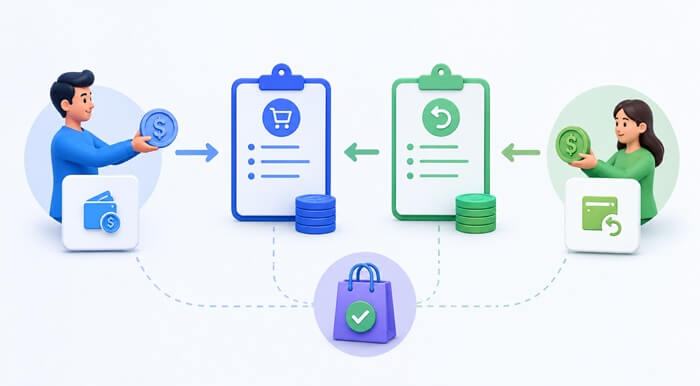
Receiving money before delivering a product or service is not the same as completing a normal sale. In Fiji VMS, Samoa TIMS and Vanuatu VSMS, a payment received partially or fully before the product or service is provided can be represented using an Advance Sale. When that advance needs to be reversed, an Advance Refund can be used and linked to the previous fiscal transaction.
This distinction is especially important for hotels taking booking deposits, construction companies receiving progress payments, businesses accepting prepayments, and companies using accounting, ERP or booking software where payment may happen weeks or months before delivery.
The three concepts businesses should keep separate are:
Proforma ≠ Advance Sale ≠ Normal Sale
A Proforma is generally used for a quotation and does not affect tax liability. An Advance Sale represents an actual payment received before delivery and does affect tax liability. A Normal Sale is used when the product or service is provided.
The exact way advance transactions are finally settled can differ according to the rules and software implementation applicable in the taxpayer's jurisdiction. Businesses should therefore avoid assuming that every advance-payment transaction must always follow exactly the same final sequence.
TL;DR: Advance Sale, Advance Refund and Normal Sale explained
| Business situation | Fiscal invoice |
|---|---|
| Quote sent, no payment received | Proforma Sale |
| Customer pays before delivery | Advance Sale |
| Advance payment is reversed or refunded | Advance Refund |
| Product or service is supplied | Normal Sale |
| Ordinary completed Sale is refunded | Normal Refund |
- Advance Sale: money has actually been received before the product or service is supplied.
- Advance Sale increases tax liability, just like a Normal Sale.
- Advance Refund: reverses or reduces an earlier advance and decreases tax liability.
- Proforma: is used for a quotation and does not create the same fiscal effect as receiving an advance payment.
- Reference Number: connects related Advance Sales, Advance Refunds and the final transaction into a traceable fiscal thread.
- Multiple deposits: should not be treated as unrelated transactions when they belong to the same sale.
- Final settlement: the exact sequence should follow the rules and implementation applicable to the taxpayer's jurisdiction.
What is an Advance Sale?
An Advance Sale is used when a customer pays partially or completely for a product or service before that product or service is provided or delivered.
Common business examples include:
- A hotel receives a booking deposit three months before the guest arrives.
- A construction company receives 30% before work begins.
- A customer pays a deposit to reserve an expensive product.
- A tour operator receives payment before the tour date.
- A business receives part of a professional-service fee before performing the work.
- A customer pays several installments before the final product is delivered.
The important point is that money has actually been received.
An Advance Sale is therefore not simply a request for payment or a quotation. It is a fiscal transaction representing an actual advance payment.
Advance Sales affect tax liability. This is one of the most important differences between an Advance Sale and a Proforma invoice.
Advance Sale vs Normal Sale: what is the difference?
The difference is primarily about when the payment and supply occur.
| Question | Advance Sale | Normal Sale |
|---|---|---|
| Has money been received? | Yes, partially or fully | Normally connected to the supplied product or service |
| Has the product/service been supplied? | Not yet | Yes |
| Does it affect tax liability? | Yes | Yes |
| Typical example | Hotel booking deposit | Hotel stay completed |
For example, imagine that a hotel room costs 1,000.
If the guest pays 300 three months before arrival, that payment can be represented as:
Advance Sale
Amount: 300
When the guest later stays at the hotel and the service is supplied, the transaction must be completed using the appropriate final fiscal workflow.
Advance Sale vs Proforma: they are not the same
This is one of the most common areas of confusion.
A Proforma Sale is generally used to provide a quotation or preliminary document to a customer. It does not mean that an advance payment has been received.
An Advance Sale, on the other hand, represents actual money received before the product or service is delivered.
| Situation | Appropriate concept | Tax liability effect |
|---|---|---|
| Business sends customer a price quotation | Proforma Sale | No |
| Customer has not paid anything yet | Proforma may be used | No |
| Customer pays a deposit before delivery | Advance Sale | Yes |
| Product or service is supplied | Normal Sale | Yes |
For example:
Hotel sends quote for stay: 1,500
        ↓
Proforma Sale

Guest pays deposit: 300
        ↓
Advance Sale
The fact that a Proforma may request payment does not turn it into an Advance Sale. The important event is the actual receipt of the customer's advance payment.
What is an Advance Refund?
An Advance Refund decreases the fiscal effect of an earlier Advance Sale.
It may be required when:
- A customer cancels and their deposit is returned.
- An advance payment needs to be corrected.
- Part of an advance is returned.
- A previously issued Advance Sale needs to be reversed.
- The applicable final-settlement workflow uses an Advance Refund before the final Normal Sale.
An Advance Refund decreases tax liability and references a previous fiscal invoice.
A simple cancellation can look like this:
Advance Sale: 200
        ↓
Customer cancels
        ↓
Advance Refund: 200
Reference → Advance Sale
The net fiscal effect of those two advance transactions is zero:
Advance Sale   +200
Advance Refund -200
-------------------
Net effect        0
An Advance Refund should not be confused with a Normal Refund. A Normal Refund normally reduces or reverses a Normal Sale, while an Advance Refund relates to an advance-payment transaction.
Why do Reference Numbers matter for advance payments?
Advance payments may involve several fiscal invoices created over a period of days, weeks or months.
The fiscalization system needs to know that all of those invoices belong to the same underlying transaction.
This relationship is created using the fiscal Reference Number.
The Reference Number is based on the SDC Invoice Number of the previously issued fiscal invoice being referenced.
For related advance transactions, the invoices form a chronological thread.
For example:
Advance Sale 1
        ↓
Advance Sale 2
Reference → Advance Sale 1
        ↓
Next transaction
Reference → immediately preceding fiscal invoice
This is different from simply storing an internal invoice number such as:
BOOKING-1005
INV-2026-001
DEPOSIT-300
Those may be useful identifiers inside the hotel's booking system, Xero, MYOB or an ERP, but the fiscal transaction thread relies on the appropriate fiscal invoice reference.
How are multiple deposits or advance payments linked?
A customer may make more than one payment before a product or service is supplied.
Consider a service costing 1,000.
The customer pays:
- First deposit: 300
- Second deposit: 200
- Remaining amount at completion: 500
The first advance payment begins the fiscal transaction thread:
Advance Sale 1
Amount: 300
When the customer later pays another 200, the second Advance Sale should remain connected to the same transaction:
Advance Sale 1: 300
        ↓
Advance Sale 2: 200
Reference → Advance Sale 1
The second deposit should not be treated as an unrelated sale if both payments relate to the same product or service.
Related advance invoices are linked chronologically so that the fiscal system can reconstruct the complete payment history.
At completion, the transaction thread is finalized according to the fiscal workflow applicable in that jurisdiction and software implementation.
How does the final Normal Sale complete an advance-payment transaction?
When the product or service is finally supplied, a Normal Sale is used to complete the business transaction.
However, the business must take into account amounts that have already been fiscalized through Advance Sales.
The final transaction should not accidentally count the same payment twice.
There are different supported settlement patterns depending on the applicable jurisdiction and implementation.
Final Normal Sale for the remaining unpaid amount
For example, current Fiji VMS guidance shows an advance-payment thread where two Advance Sales are followed by a Normal Sale representing only the remaining unpaid amount.
For a service costing 9,000:
Advance Sale 1: 3,000
        ↓
Advance Sale 2: 3,000
Reference → AS1
        ↓
Normal Sale: 3,000
Reference → AS2
Total fiscalized value:
3,000 + 3,000 + 3,000 = 9,000In this model, the final Normal Sale covers only the difference between the total price and the Advance Sales that have already been declared.
This is why businesses should not assume that the final Normal Sale must always contain the full contract price.
How an Advance Refund settlement chain can work
Another advance-payment settlement model uses an Advance Refund to reverse the amounts already fiscalized through Advance Sales before a final Normal Sale records the full completed transaction.
Consider a service with a total value of 1,000.
The customer has already paid:
- First advance: 300
- Second advance: 200
The advance-payment thread begins:
AS1: 300
        ↓
AS2: 200
Reference → AS1
Total advance already fiscalized:
500In an Advance Refund settlement model, the advance amount can then be reversed:
Advance Refund: 500
Reference → advance transaction thread
The final completed Sale can then be issued for the full value:
Normal Sale: 1,000
Reference → preceding Advance Refund
Visually:
AS 300 → AS 200 → AR 500 → NS 1,000The fiscal effect is:
| Transaction | Fiscal effect |
|---|---|
| Advance Sale 1 | +300 |
| Advance Sale 2 | +200 |
| Advance Refund | −500 |
| Normal Sale | +1,000 |
| Final net Sale | 1,000 |
This example is useful for understanding why an Advance Refund can form part of a final settlement rather than only being used when a customer cancels.
However, businesses should not assume that every advance-payment transaction must always be settled using an Advance Refund before the final Normal Sale.
Published jurisdiction-specific guidance can prescribe or demonstrate different settlement workflows. The business should follow the rules and fiscalization implementation applicable to its jurisdiction.
Example: one advance payment
A customer orders a product or service costing 1,000.
Before delivery, the customer pays a deposit of 300.
Because money has actually been received, this is not merely a quotation.
Total order: 1,000

Deposit received: 300
        ↓
Advance Sale: 300
The Advance Sale records the payment that occurred before supply.
Later, when the product or service is supplied, the final transaction must remain connected to the advance-payment history and be completed using the settlement workflow applicable to the business.
Example: hotel booking with deposits
Advance payments are particularly common in accommodation businesses.
A guest books a stay costing 1,500.
Three months before arrival
The guest pays a deposit of 300.
Advance Sale 1
Amount: 300
One month before arrival
The guest pays another 500.
Advance Sale 2
Amount: 500
Reference → Advance Sale 1
Total received before the stay:
300 + 500 = 800At checkout
The accommodation service has now been provided.
The advance-payment thread must be completed using the appropriate Normal Sale and, where required by the applicable settlement model, Advance Refund workflow.
The important point is that the fiscal system should be able to connect:
First deposit
        ↓
Second deposit
        ↓
Final hotel Sale
They should not appear as three unrelated transactions when they all belong to the same guest stay.
This is particularly important for hotel systems, property management systems and accounting integrations that may store booking numbers separately from fiscal invoice numbers.
Example: construction or project paid in installments
Construction, consulting and project-based businesses often receive several payments before the entire project is delivered.
Consider a project costing 10,000.
The agreed payment schedule is:
- 30% when the contract starts: 3,000
- 30% during the project: 3,000
- 40% when the project is completed: 4,000
If the first payments qualify as advance payments under the applicable rules, the transaction thread might begin:
Advance Sale 1: 3,000
        ↓
Advance Sale 2: 3,000
Reference → Advance Sale 1
When the work is supplied or completed, the final fiscal transaction is issued according to the applicable settlement workflow.
For example, a remaining-balance model would produce:
AS 3,000 → AS 3,000 → NS 4,000The total fiscalized value remains:
3,000 + 3,000 + 4,000 = 10,000Businesses should also be careful with terminology such as “deposit”, “milestone”, “progress payment” and “installment”. The name used in a contract or accounting system does not by itself determine the fiscal treatment.
The business should consider when payment is received, when supply occurs and how the applicable rules treat that payment.
What happens if the customer cancels after paying a deposit?
Consider a hotel booking with a total value of 800.
The guest initially pays a 200 deposit:
Advance Sale: 200The guest later cancels, and the business returns the full 200.
The advance can be reversed using:
Advance Refund: 200
Reference → original Advance Sale
The resulting fiscal effect is:
Advance Sale:   +200
Advance Refund: -200
--------------------
Net:                0
The Reference Number is important because it establishes which Advance Sale is being reversed.
If only part of the deposit is returned, the business should follow the applicable rules for partial refunds and any amount that is retained.
Does this apply to Fiji VMS, Samoa TIMS and Vanuatu VSMS?
The core concepts of Normal, Advance, Sale, Refund and Proforma are used in the fiscal systems supported by FiscoBridge in Fiji, Samoa and Vanuatu.
However, businesses should pay particular attention to the final settlement workflow because jurisdiction-specific guidance may differ.
How do advance payments work in Fiji VMS?
Fiji VMS defines an Advance invoice as an invoice used when a customer pays partially or completely before a product or service is provided or delivered.
Advance Sale increases tax liability, while Advance Refund decreases tax liability.
FRCS guidance also explains how related advance invoices should be connected through Reference Numbers. Where several Advance Sales belong to the same transaction, the subsequent invoice references the preceding advance invoice.
Current Fiji VMS Phase 3 guidance includes an example where two Advance Sales are followed by a final Normal Sale for only the remaining unpaid amount. The final Normal Sale references the preceding Advance Sale.
How do advance payments work in Samoa TIMS?
Samoa TIMS also defines an Advance invoice as an invoice issued where the customer pays partially or fully before the service or product is provided.
Advance Sale increases tax liability and Advance Refund decreases tax liability.
Samoa's official guidance explains that invoices belonging to the same advance-payment transaction should be linked into a chronological thread using the SDC Invoice Number of the preceding fiscal invoice as the Reference Number.
How do advance payments work in Vanuatu VSMS?
Vanuatu VSMS uses the same core fiscal invoice types, including Normal, Advance and Proforma, together with Sale and Refund transaction types.
Businesses accepting deposits or prepayments should ensure that their POS, accounting software, ERP or booking system preserves the necessary fiscal references so related advance transactions can be correctly connected.
The exact settlement workflow should follow the current guidance and implementation applicable in Vanuatu.
What should accounting, POS and ERP systems do with advance payments?
Advance-payment workflows become more complicated when the payment begins in another business application.
For example, a hotel may receive a deposit through a booking system, record it in an accounting application and later create the final invoice from a property management system.
A correct fiscalization workflow needs more information than simply the amount received.
The integration should be able to understand:
- Whether money has actually been received.
- Whether the product or service has already been supplied.
- Whether the transaction should be a Proforma, Advance Sale or Normal Sale.
- Whether the payment belongs to an existing advance-payment thread.
- Which fiscal invoice was issued for the previous advance payment.
- Which SDC Invoice Number should be used as the Reference Number.
- Whether an Advance Refund is required.
- How much remains to be charged when the final Sale is issued.
- How cancellation or partial refund scenarios should be handled.
Simply treating every payment as an unrelated Normal Sale can break the relationship between the advance payment and the final transaction.
Similarly, issuing only a Proforma after money has actually been received may not represent the payment correctly where the applicable rules require an Advance Sale.
Common mistakes with Advance Sale and Advance Refund invoices
Issuing only a Proforma after receiving payment
A Proforma is a quotation and does not have the same fiscal effect as an Advance Sale.
If money has actually been received before delivery and the payment qualifies as an advance under the applicable rules, businesses should determine whether an Advance Sale is required.
Issuing a Normal Sale too early
A Normal invoice is associated with a product or service being provided. An Advance invoice is specifically designed for situations where payment occurs before supply.
Businesses should check the correct treatment rather than automatically issuing a Normal Sale whenever money is received.
Failing to reference the previous Advance Sale
Where multiple Advance Sales belong to the same transaction thread, they should remain connected through the appropriate fiscal Reference Numbers.
Without that relationship, the fiscal system may see separate transactions rather than a sequence of payments toward the same final supply.
Treating several deposits as unrelated transactions
A guest may pay 300 today and 500 next month for the same hotel booking.
If both are advance payments for the same stay, the fiscal workflow should preserve the connection between them.
Ignoring amounts already fiscalized as Advance Sales
A business should not create a final Sale without considering amounts that were already declared through Advance Sales.
Otherwise, the transaction may be counted incorrectly.
Assuming every final Sale must always use an Advance Refund first
An Advance Refund can form part of a settlement model, including a sequence such as:
AS → AS → AR → NSHowever, businesses should not assume that this is the mandatory final-settlement sequence in every supported jurisdiction.
For example, published Fiji VMS Phase 3 guidance also demonstrates Advance Sales followed directly by a Normal Sale containing only the remaining unpaid balance.
Confusing an Advance Refund with a Normal Refund
An Advance Refund relates to an advance-payment transaction.
A Normal Refund generally reverses or reduces an ordinary completed Normal Sale.
Assuming anything called a “deposit” is automatically an Advance Sale
The word “deposit” can describe different business arrangements.
Businesses should consider whether the amount represents income or payment toward a future supply, whether it may be refundable, and what the applicable tax rules require.
Losing the fiscal invoice reference
An ERP, booking system or accounting platform may know that payment DEPOSIT-001 belongs to invoice INV-500, but the fiscalization system also needs the appropriate fiscal invoice relationship.
Integrations should preserve the SDC Invoice Numbers returned during fiscalization so later advance transactions can reference them correctly.
How FiscoBridge can help with advance-payment workflows
Advance payments can become more complicated when invoices and payments originate in accounting software, ERP systems, hotel systems, POS applications or other business software.
A fiscalization integration needs to understand not only the amount being paid, but also where that payment belongs in the transaction history and which previously issued fiscal invoice it should reference.
FiscoBridge provides fiscalization solutions for Fiji VMS, Samoa TIMS and Vanuatu VSMS, including accounting and ERP integrations and FiscoBridge SDC for compatible POS and ERP systems.
If your business accepts deposits, installments or advance payments, the existing sales workflow should be reviewed before implementation.
Important questions include:
- Where is the deposit recorded?
- When is payment considered received?
- When is the final product or service supplied?
- Does the existing software support Advance Sale and Advance Refund transactions?
- Can it store the SDC Invoice Number of previous fiscal transactions?
- Can it link multiple deposits to the same transaction?
- How are cancellations and returned deposits handled?
- Which final-settlement workflow applies in the business's jurisdiction?
Do you accept deposits or advance payments?
Contact FiscoBridge to discuss how your existing POS, accounting software, hotel system or ERP can support the appropriate fiscal workflow.
Frequently asked questions about advance payments and deposits
What is an Advance Sale?
An Advance Sale is used when a customer pays partially or completely for a product or service before it is provided or delivered. Unlike a Proforma, an Advance Sale represents an actual payment and increases tax liability.
What is an Advance Refund?
An Advance Refund reduces or reverses an amount previously recorded through an Advance Sale. It decreases tax liability and should contain the appropriate reference to the previous fiscal transaction.
Is a deposit an Advance Sale?
A deposit that represents payment received toward a future product or service may need to be treated as an Advance Sale under the applicable rules. However, not every amount described as a “deposit” automatically has the same fiscal treatment, so businesses should consider the nature of the payment and applicable jurisdiction requirements.
What is the difference between an Advance Sale and a Proforma?
A Proforma is generally used for a quotation and does not affect tax liability. An Advance Sale represents actual payment received before delivery and does affect tax liability.
Can I issue a Proforma when asking a customer for a deposit?
A Proforma can be used as a quotation or payment request before money is received. Once an actual advance payment is received, the business should determine whether that payment must be represented through an Advance Sale under the applicable rules.
Does an Advance Sale increase tax liability?
Yes. The fiscal transaction model defines both Normal Sale and Advance Sale as transactions that increase tax liability.
Does an Advance Refund decrease tax liability?
Yes. Advance Refund is a Refund transaction and decreases tax liability.
Does an Advance Refund need to reference the original Advance Sale?
An Advance Refund needs the appropriate fiscal Reference Number identifying the preceding fiscal transaction it is reversing or continuing within the advance-payment thread.
How are multiple advance payments linked?
When several Advance Sales belong to the same transaction, they should be connected chronologically using fiscal Reference Numbers. A subsequent advance references the appropriate preceding fiscal invoice in the transaction thread.
What is the Reference Number on an advance invoice?
The Reference Number is based on the SDC Invoice Number of the fiscal invoice being referenced. It allows related Advance Sales, Advance Refunds and final transactions to remain connected.
Does the final Normal Sale reference an advance invoice?
Where the Normal Sale completes an advance-payment transaction thread, the applicable fiscal workflow uses the required fiscal reference to connect the final transaction to the preceding advance history. The exact preceding invoice and settlement sequence depend on the jurisdiction and implementation.
Do all Advance Sales have to be refunded before the final Normal Sale?
No universal rule should be assumed across all implementations. One supported settlement model uses Advance Sale, Advance Refund and then Normal Sale, while current Fiji VMS guidance also shows multiple Advance Sales followed directly by a final Normal Sale for only the remaining unpaid balance. Businesses should follow the rules applicable to their jurisdiction and fiscal software.
How does the AS → AR → NS settlement model work?
In this model, Advance Sales first record payments received before supply. An Advance Refund then reverses the advance amounts already included in tax liability, after which a Normal Sale records the completed transaction. This avoids counting both the advances and the full final Sale in the net transaction value.
What happens if a customer cancels after paying an advance?
If the advance is returned, an Advance Refund can reverse the relevant Advance Sale and reference the earlier fiscal transaction. The treatment of any amount retained by the business should follow the applicable contractual and tax rules.
How do hotel deposits work with fiscalization?
If a hotel receives payment before the guest's stay and the payment qualifies as an advance, it can be represented using an Advance Sale. Additional payments for the same stay should remain connected through the fiscal transaction thread, and the final stay should be completed according to the applicable settlement workflow.
How do construction advance payments work with fiscalization?
Where construction or project payments are received before the relevant supply and qualify as advance payments, Advance Sale invoices can be used and linked chronologically. The final fiscal treatment depends on when supply occurs and the jurisdiction-specific rules for installments and advance payments.
Can accounting software handle Advance Sale and Advance Refund automatically?
It depends on the accounting software and integration. The integration needs to distinguish quotations, advance payments, refunds and completed sales, while also preserving the fiscal SDC Invoice Numbers required to connect related transactions. Businesses with advance-payment workflows should review these requirements before implementation.
Do advance-payment rules work exactly the same in Fiji VMS, Samoa TIMS and Vanuatu VSMS?
The systems share the concepts of Advance Sale, Advance Refund, Normal Sale, Refund and fiscal Reference Numbers, but businesses should not assume that every final-settlement workflow is identical. The current rules and implementation for the specific jurisdiction should be followed.
Official sources
The concepts and examples in this article are based on the official fiscalization guidance published for the systems supported by FiscoBridge.
- Fiji VMS – Invoice and Transaction Types
- Fiji VMS – Reference Number
- FRCS – VMS Phase 3 Guide
- Fiji VMS – Invoice Verification and Advance Payment Recapitulation
- Samoa TIMS – Invoice and Transaction Types
- Samoa TIMS – Reference Number
- Vanuatu VSMS – Invoice and Transaction Types
- Vanuatu VSMS – Reference Number
Businesses should check the latest guidance from their local tax authority and confirm unusual deposit, installment or advance-payment workflows with their accountant, tax adviser or fiscalization provider.