
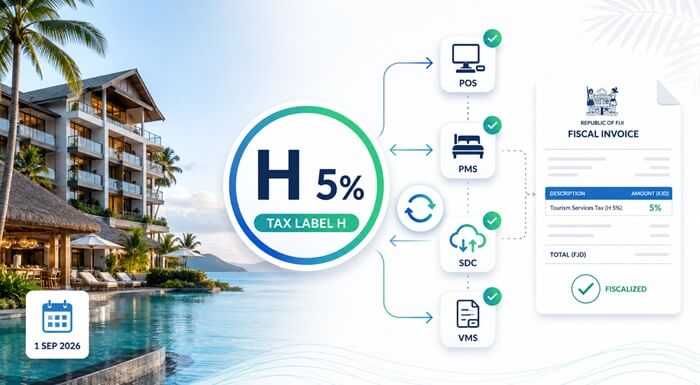
Fiji's 5% Tourism Services Tax (TST) takes effect from 1 September 2026, and FRCS has introduced a new fiscal Tax Label “H” for the tax. For affected hotels, resorts and other tourism operators, this is not only an accounting change: the POS, PMS, invoicing software and Sales Data Controller (SDC) workflow must be able to calculate, display and fiscalize the new tax correctly.
FRCS has instructed POS and SDC developers to incorporate the new H · 5% tax label into their systems. At the same time, September brings another major deadline for larger accommodation businesses: Accommodation Group 2 has a Fiji VMS V3 implementation due date of 30 September 2026.
That means many large Fiji hotels and resorts now have two immediate questions: does TST apply to our bookings, and is our invoicing/fiscalization system ready to issue the correct VMS fiscal invoice?
TL;DR: What Fiji hotels and resorts need to do now
- TST starts 1 September 2026.
- The TST rate is 5%.
- FRCS has introduced VMS Tax Label H for TST.
- Tax Label H must be incorporated into POS and SDC systems.
- TST applies to prescribed tourism services where the relevant tourism-services turnover exceeds the FJD 2 million threshold.
- The booking date determines whether a tourism service falls into the TST period.
- TST and VAT must be calculated separately on the underlying service charge — no tax-on-tax.
- TST must be shown separately on the customer's tax invoice, invoice or receipt.
- Taxable deposits and instalments must also be handled correctly as money is collected.
- Accommodation Group 2 VMS V3 implementation is due 30 September 2026.
- The TST threshold and the Accommodation Group 2 threshold are not the same test.
↓
Determine whether TST applies to the booking and service
↓
Apply VAT separately where applicable
+
Apply TST using Tax Label H · 5%
↓
Send the correct tax labels through the VMS fiscalization workflow
↓
Show VAT and TST separately on the guest invoice / receipt
What changed on 1 September 2026?
FRCS has confirmed that the 5% Tourism Services Tax commences on 1 September 2026.
The tax was initially proposed to start on 1 July 2026, but the commencement date was moved to 1 September to provide the tourism industry with additional time to prepare its systems and operational processes.
For fiscal invoicing, FRCS has introduced a new tax category:
| Fiscal tax label | Tax | Rate | Effective |
|---|---|---|---|
| H | Tourism Services Tax (TST) | 5% | 1 September 2026 |
FRCS specifically states that the new Tax Label H must be incorporated into POS and SDC systems.
This matters because simply creating a new 5% account in your general ledger does not automatically make a VMS fiscal invoice correct. The tax must pass through the complete invoice flow using the correct fiscal tax category.
Which tourism businesses are affected by the 5% TST?
According to the current FRCS Standard Interpretation Guideline, TST applies to prescribed tourism services provided by businesses whose aggregate annual gross turnover from those prescribed tourism services exceeds FJD 2 million.
The threshold is based on turnover from the prescribed tourism services — not necessarily the total turnover from every activity operated by the company.
For example, FRCS gives a resort example where tourism-service turnover includes:
- Resort accommodation
- Hotel bar and club income
- Water-sports activities
In the same example, commercial rental and supermarket income are excluded from the prescribed tourism-services turnover calculation.
Which hotel and resort services can be subject to TST?
For a licensed hotel, FRCS guidance identifies accommodation, refreshments and other services provided to guests as prescribed tourism services.
Examples specifically listed by FRCS include:
- Accommodation
- Room service
- Laundry service
- Telephone charges
- Refreshments
- Other services included in the guest's bill
The prescribed tourism-services list also covers other categories, including:
- Services provided on qualifying tourist vessels
- Meals and beverages served by a licensed bar or club located within hotel premises
- Inbound tour services, including transfers and guided tours
- Water-sports services such as diving, snorkelling, surfing and river safaris
- Services substantially similar in nature to the prescribed services
FRCS notes that the nature and substance of the service matters, not only the name a business gives it.
This is particularly important for resorts where a single guest folio can include room charges, restaurant or bar items, laundry, phone charges, excursions and recreational activities.
What is Fiji VMS Tax Label H?
Tax Label H is the new 5% TST fiscal tax label introduced by FRCS.
VMS fiscal invoices do not work only with a percentage entered into accounting software. Fiscal transactions use the tax labels recognised by the fiscal system.
For an affected hotel or resort, this means the invoicing chain needs to preserve the correct tax treatment:
↓
Correct business tax configuration
↓
Fiscal tax mapping includes H · 5% where TST applies
↓
POS / SDC / integration fiscalizes the invoice
If a hotel has a PMS or accounting system connected to a fiscalization provider, the tax mapping between the source software and the VMS fiscal tax labels must also be checked.
Adding “TST 5%” to the printed guest bill is not enough if the VMS fiscal transaction itself is still being submitted without Tax Label H.
How should VAT and TST be calculated together?
TST is separate from VAT.
FRCS guidance states that TST is charged at 5% of the price of the tourism service and must be shown separately from VAT. VAT is not calculated on the TST amount, and TST is not calculated on the VAT amount.
Both taxes are calculated independently on the underlying service charge.
Example: FJD 100 taxable tourism service
Using the current standard VAT rate shown in the FRCS TST guideline:
| Component | Calculation | Amount |
|---|---|---|
| Service charge | Base amount | FJD 100.00 |
| VAT | 100 × 12.5% | FJD 12.50 |
| TST | 100 × 5% | FJD 5.00 |
| Total payable | 100 + 12.50 + 5.00 | FJD 117.50 |
The wrong calculation would be to add TST and then calculate VAT on the TST-inclusive amount, or to calculate TST on the VAT-inclusive amount.
The correct principle is:
→ calculate VAT separately
→ calculate TST separately
→ display both separately
FRCS also requires the TST amount to be clearly and separately disclosed on the tax invoice, invoice or receipt given to the customer.
Which hotel bookings are subject to TST?
This is one of the most important operational rules for hotels.
Under the current FRCS guideline, the booking date determines whether the tourism service is subject to TST.
A confirmed booking can be established through a reservation, invoice or payment event. FRCS describes a confirmed booking as one where the customer or authorised agent accepts the offer and the operator records a committed reservation with the relevant customer, service, date, price or pricing basis, and booking reference.
FRCS provides the following timing approach:
| Booking date | Service date | TST |
|---|---|---|
| Before 1 September 2026 | Before 1 September 2026 | No TST |
| Before 1 September 2026 | On or after 1 September 2026 | No TST |
| On or after 1 September 2026 | During the applicable TST period | TST applies, subject to the other tests |
This means a hotel cannot determine TST simply by asking, “Did the guest stay after 1 September?”
The PMS or reservation workflow may need to retain the original confirmed booking date so the correct tax treatment is applied later when the guest pays or checks out.
What happens with deposits and instalments?
Hotels and resorts commonly collect deposits before arrival, so TST setup cannot focus only on the final checkout invoice.
For a taxable booking, FRCS guidance says TST is collected as consideration is received, including deposits and instalments.
If only part of the booking is paid, the proportionate TST attributable to that payment is collected and reported.
Simple example
A qualifying hotel has a taxable booking with a service charge of FJD 1,000. The guest pays a FJD 300 instalment.
The system needs to recognise that the payment relates to a TST-taxable booking and collect the applicable portion of TST on that payment according to the required workflow.
This is where the connection between your booking engine, PMS, payment process and fiscal invoicing system becomes important.
If your business also uses fiscal Advance Sale and Advance Refund transactions for deposits, review the separate FiscoBridge guide:
Advance Payments and Deposits: How Advance Sale and Advance Refund Work
What exactly must your POS, PMS or accounting system support?
For an affected hotel or resort, TST readiness should be checked across the complete invoice path, not only in the accounting ledger.
1. Tax Label H must be available in the fiscalization workflow
The POS and SDC path must be able to process the new H · 5% tax label where applicable.
2. Your source system must know which charges are TST-taxable
The business needs to identify which room, food, beverage, hotel service, tour, water-sport or other charges fall under the prescribed tourism-services rules.
3. VAT and TST must be handled separately
The system must not calculate VAT on TST or TST on VAT.
4. TST must appear separately on customer documents
The customer's tax invoice, invoice or receipt must clearly show the TST amount separately.
5. Booking-date rules must be considered
For hotel bookings around the 1 September transition date, the business may need to distinguish older confirmed bookings from bookings created after TST commenced.
6. Deposits and instalments must be handled
If a taxable guest booking is paid in stages, the tax treatment should follow the payment collection rules rather than waiting blindly until checkout.
7. Tax mapping between systems must be updated
If your PMS, Xero, MYOB, Cloudbeds, Odoo or ERP sends invoices to a fiscalization integration, the mapping must preserve the new TST treatment.
8. Refunds and cancellations must be tested
Hotels should test how TST is reversed when a qualifying booking or charge is cancelled or refunded.
How TST connects with the 30 September VMS deadline for Accommodation Group 2
September 2026 now contains two important compliance milestones for large Fiji accommodation businesses.
| Date | Change | What it means |
|---|---|---|
| 1 September 2026 | 5% Tourism Services Tax starts | Affected systems need the new TST treatment and VMS Tax Label H. |
| 30 September 2026 | Accommodation Group 2 VMS implementation deadline | Businesses in this group should have their VMS V3 fiscal invoicing setup implemented. |
For an Accommodation Group 2 hotel or resort that is also subject to TST, this means the VMS implementation cannot be tested using only the old tax configuration.
The production workflow now needs to be ready for the September tax structure as well.
That includes every place a taxable guest charge can originate:
- Front desk / reception
- Property Management System (PMS)
- Booking engine
- Restaurant POS
- Bar POS
- Room service
- Laundry
- Tour desk
- Water-sports desk
- Accounting software
- ERP or back-office system
For a broader checklist on the VMS deadline, see:
Fiji VMS for Accommodation Group 2: what hotels and resorts need before 30 September 2026
Do not confuse the TST threshold with the Accommodation Group 2 VMS threshold
The two September compliance topics are related operationally, but the thresholds come from different rules.
| Requirement | Relevant threshold / group |
|---|---|
| Tourism Services Tax | Aggregate annual gross turnover from prescribed tourism services exceeds FJD 2 million, subject to the TST rules. |
| Accommodation Group 2 VMS Phase 3 | Accommodation businesses described in the Gazette whose annual sales turnover is more than FJD 5 million. |
This creates several possible situations.
A resort with FJD 6 million annual sales
It may fall into Accommodation Group 2 for VMS. It should also separately determine whether its prescribed tourism-services turnover exceeds the FJD 2 million TST threshold.
A hotel with FJD 3 million prescribed tourism-services turnover
It may be subject to TST even though it is not Accommodation Group 2. Its VMS implementation timeline may therefore come from a different accommodation group.
Do not use one threshold as a shortcut for the other.
Practical Fiji hotel examples
Example 1: New booking made on 1 September
A qualifying resort receives a confirmed accommodation booking on 1 September 2026.
The service is a prescribed tourism service and the business exceeds the TST threshold.
The booking falls into the TST period, so the applicable tourism charges need to use the correct TST treatment.
→ qualifying tourism service
→ business exceeds TST threshold
→ TST applies
→ fiscal workflow includes Tax Label H · 5%
Example 2: Booking made before 1 September, stay after 1 September
A guest confirmed a booking in August 2026 for a stay in October 2026.
Under the current FRCS booking-date guidance, a booking made before 1 September is not brought into TST simply because the service is consumed later.
This is why the original reservation date needs to remain available to the invoicing process.
Example 3: FJD 100 room-service charge
For a qualifying taxable service charge of FJD 100:
- Service charge: FJD 100.00
- VAT at 12.5%: FJD 12.50
- TST at 5%: FJD 5.00
- Total: FJD 117.50
The VAT and TST amounts must be separate — both in the calculation and on the customer document.
Example 4: Resort with mixed income
A resort may have accommodation, bar, water-sports, supermarket and commercial-rental income.
Do not assume total company turnover is automatically the TST turnover figure. FRCS guidance requires the operator to identify turnover from the prescribed tourism services when applying the FJD 2 million threshold.
What if your hotel uses Xero, MYOB, Cloudbeds, Odoo or an existing POS?
The key question is where the guest charge is created and how its tax information reaches VMS.
Existing hotel or restaurant POS
If you want to keep your existing local POS, it must be able to send the appropriate tax labels through the fiscalization workflow. FiscoBridge SDC can act as the local fiscalization layer for compatible POS and ERP systems.
Xero, MYOB or other cloud accounting software
If fiscal invoices originate in supported cloud accounting software, the tax mapping must be reviewed so TST-taxable transactions can be represented correctly in the fiscal invoice.
FiscoBridge provides cloud integrations for supported accounting and ERP platforms.
Cloudbeds or another PMS
Hotel PMS integrations need particular care because the guest folio may combine room charges and other services, while the booking date may also determine the TST treatment.
If your PMS connects to the fiscalization workflow, confirm that the relevant taxes and service charges are mapped correctly before live use.
Web Invoicing
Businesses using a simple browser-based invoice workflow should also confirm that the current tax configuration includes the correct TST label before issuing affected invoices.
The important principle is the same regardless of software:
↓
Correct tax mapping
↓
Tax Label H reaches VMS
↓
Customer invoice separately shows TST
What should hotels test before issuing live TST fiscal invoices?
A basic “invoice successfully sent” test is not enough for a hotel.
Before relying on the updated workflow, test at least:
- A new accommodation booking created on or after 1 September 2026.
- A booking created before 1 September but consumed afterward.
- A standard room charge with VAT and TST.
- Room service.
- Hotel bar or club charges where applicable.
- Laundry and other guest-bill services.
- A deposit or instalment on a taxable booking.
- A final payment at checkout.
- A cancellation.
- A full refund.
- A partial refund.
- A guest folio containing both TST-taxable and non-TST items, where applicable.
- The fiscal receipt produced through VMS.
- The customer-facing invoice or receipt.
Check that:
- Tax Label H is present where TST applies.
- The 5% rate is correct.
- VAT is calculated separately.
- There is no tax-on-tax calculation.
- The TST amount is separately disclosed.
- The PMS/accounting totals reconcile with the fiscal invoice.
Common TST and Tax Label H mistakes to avoid
Adding 5% in accounting but not updating VMS fiscalization
The new tax is not only a general-ledger setting. FRCS specifically requires the new Tax Label H to be incorporated into POS and SDC systems.
Calculating VAT on top of TST
FRCS states that TST is not subject to VAT and VAT is not subject to TST. Both are calculated separately on the underlying tourism-service charge.
Hiding TST inside a combined tax amount
TST needs to be separately disclosed on the invoice or receipt.
Applying TST only based on the stay date
The current FRCS guideline uses the booking date to determine whether the tourism service falls into the TST period.
Ignoring deposits
For a taxable booking, TST collection also needs to be considered when deposits and instalments are received.
Using total company turnover instead of prescribed tourism-services turnover
The TST threshold test is based on aggregate turnover from prescribed tourism services. Businesses with mixed activities need to separate the relevant turnover.
Assuming TST and Accommodation Group 2 use the same threshold
They do not. TST currently uses a FJD 2 million prescribed-tourism-services threshold, while Accommodation Group 2 in the VMS Gazette covers accommodation businesses with annual sales turnover above FJD 5 million.
Updating reception but forgetting restaurant, bar or PMS integrations
A resort may issue guest charges from several systems. Every relevant path to the final fiscal invoice should be reviewed.
How FiscoBridge can help hotels prepare for Tax Label H and VMS V3
For hotels and resorts, the challenge is often not the 5% calculation itself. The difficult part is making sure the same correct tax treatment reaches the fiscal invoice from the software staff already use.
FiscoBridge supports different Fiji VMS workflows, including:
- FiscoBridge SDC for compatible local POS and ERP systems.
- Cloud integrations for supported accounting, ERP and hospitality platforms.
- FiscoBridge Web Invoicing for simpler browser-based invoicing.
- FiscoBridge Desktop POS for businesses that need a complete POS solution.
If your hotel already uses a PMS, Xero, MYOB, Cloudbeds, Odoo, a restaurant POS or a custom ERP, the first step is to review where taxable charges are created and whether that system can pass the correct TST information into the fiscalization workflow.
September 2026 is not the month to discover that your accounting totals are correct but your VMS tax labels are not.
Need help checking your hotel or resort setup?
Tell FiscoBridge which PMS, POS, accounting system or ERP you use. We can help review the fiscalization path and the changes needed for Fiji VMS V3 and the new Tax Label H workflow.
Frequently asked questions about Fiji TST, Tax Label H and VMS
When does Fiji's 5% Tourism Services Tax start?
FRCS has confirmed that the 5% Tourism Services Tax starts on 1 September 2026.
What is Fiji VMS Tax Label H?
Tax Label H is the new VMS fiscal tax label introduced by FRCS for the 5% Tourism Services Tax. FRCS has instructed POS and SDC developers to incorporate the label into their systems.
Does every Fiji hotel have to charge TST?
No. The current FRCS guidance applies TST to prescribed tourism services where the operator meets the relevant requirements, including an aggregate annual gross-turnover threshold exceeding FJD 2 million from prescribed tourism services. Businesses should apply the full FRCS test to their circumstances.
What hotel services are subject to TST?
For licensed hotels, FRCS guidance includes accommodation, refreshments and other guest services such as room service, laundry, telephone charges and other services included in the guest bill. Other prescribed tourism-service categories include qualifying hotel bars/clubs, inbound tour operators, water-sports providers and similar services.
Is TST charged on top of VAT?
TST and VAT are both calculated separately on the underlying service charge. VAT is not calculated on TST and TST is not calculated on VAT.
Does TST need to appear separately on the hotel invoice?
Yes. FRCS guidance states that TST must be clearly and separately shown on the tax invoice, invoice or receipt issued to the customer.
If a guest booked before 1 September but stays after 1 September, does TST apply?
Under the current FRCS booking rules, the booking date determines whether the tourism service falls into the TST period. The guideline shows that a booking made before 1 September 2026 is not subject to TST merely because the service is rendered after that date.
Does a deposit trigger TST?
For a taxable booking, FRCS guidance says TST is collected as consideration is received, including deposits and instalments. A proportionate amount is collected and reported when part payment is received.
Does my POS need to support Tax Label H?
If your POS is part of the VMS fiscal invoicing workflow for TST-taxable transactions, it needs to handle the correct fiscal tax treatment. FRCS specifically states that Tax Label H must be incorporated into POS and SDC systems.
Does my SDC need to be updated for TST?
Yes. FRCS's Tax Label H notice is addressed to POS and SDC developers and requires the new label to be incorporated into the systems.
What is the VMS deadline for Accommodation Group 2?
FRCS lists Accommodation Group 2 with registration due on 30 June 2026 and implementation due on 30 September 2026.
Which businesses are in Accommodation Group 2?
The relevant Fiji Gazette describes Accommodation Group 2 as accommodation businesses including hotels, resorts and other listed accommodation operators whose annual sales turnover is more than FJD 5 million.
Is the TST FJD 2 million threshold the same as the VMS Accommodation Group 2 threshold?
No. They are different tests. TST uses the prescribed-tourism-services turnover test described in the TST rules, currently exceeding FJD 2 million. Accommodation Group 2 for VMS uses the separate accommodation-group definition with annual sales turnover above FJD 5 million.
Can I keep my existing hotel POS or PMS?
Possibly. If the existing POS, PMS, ERP or accounting system can pass the required invoice and tax information into a compatible fiscalization solution, the business may not need to replace its entire system. The new Tax Label H and TST rules still need to be supported correctly.
Can Xero or MYOB invoices include TST in the VMS integration?
The source accounting tax setup and FiscoBridge fiscal tax mapping need to be configured so the correct VMS tax labels are applied. Businesses should review their integration and test TST transactions before relying on live processing.
What should a Fiji hotel test before 30 September?
Hotels should test new bookings, pre-1 September bookings, accommodation charges, guest services, VAT plus TST calculations, deposits, final payments, refunds, tax-label mapping and the final VMS fiscal receipt.
Official sources
- FRCS – Implementation of Tourism Services Tax (TST): Tax Label H effective 1 September 2026
- FRCS – Tourism Services Tax commences from 1 September 2026
- FRCS – Tourism Services Tax notice and Standard Interpretation Guideline
- FRCS – Standard Interpretation Guideline 2026-09: Tourism Services Tax
- FRCS – VMS Phase 3 timelines
- Fiji Government Gazette – Phase 3 groups and Accommodation Group 2 definition
This article summarises current FRCS guidance for practical system preparation. Tourism operators should review the current legislation and FRCS guidance and obtain professional tax advice where the treatment of a particular service, booking, package or transaction is uncertain.